

Casinos prove games aren't rigged by combining certified RNG design, independent lab audits, controlled releases, and continuous production monitoring. For you, the practical path is online casino fairness verification: confirm RNG certification for online casinos, verify the game build matches the certified version, and sanity-check outcomes with basic statistical tests and log evidence. This is the core of casino RNG testing.
Pre-play verification checklist for RNG fairness
- Find the casino's regulator/licence details and match them to the operator name and domain you are using.
- Locate the provider/game "RNG certificate" or lab report reference (lab name, date, scope, game/RNG module).
- Confirm the certificate covers the exact game/provider and not a different brand, region, or platform.
- Check for a stated RTP range/version and whether the operator offers multiple RTP configurations.
- Verify that the casino shows a responsible disclosure path for integrity issues (support channel + incident policy).
RNG fundamentals: algorithms, entropy sources, and seeding
This section is for intermediate users who want to understand what a casino is actually proving during independent casino game auditing: that outcomes come from a properly designed and controlled random number generator (RNG), not from hidden rules or operator manipulation. Don't try to "reverse engineer" proprietary binaries or bypass security controls; you can validate fairness using published artifacts (certificates, versioning, logs, and high-level test evidence) without unsafe steps.
- Algorithm: typically a cryptographic PRNG (CSPRNG) or DRBG; "random-looking" is not enough-predictability must be infeasible.
- Entropy source: hardware/OS entropy used to seed/reseed the generator; weak entropy undermines everything.
- Seeding & reseeding: the seed must be unpredictable, handled securely, and refreshed per a defined policy.
- Separation of concerns: RNG module should be isolated from payout/RTP configuration logic.
- Determinism vs fairness: PRNG outputs are deterministic given a seed; fairness depends on secure seeding, correct implementation, and controls.
Regulatory frameworks and independent certification standards
To replicate (at a user level) what regulators and labs check, you'll need a few specific items and access points. This is the practical backbone behind how casinos prove games are fair in a way you can verify.
- Licence and regulator reference: licence number (or equivalent) and the legal entity name used by the casino.
- Lab identity and scope: a named testing lab (the "independent" in independent casino game auditing) and what exactly was tested (RNG module, game math, platform).
- Certificate metadata: issue date, validity/retention policy, version/build identifiers, and covered jurisdictions.
- Version evidence: game build/version string in the client, provider info screen, or help page; release notes if provided.
- RTP disclosure: stated RTP and whether multiple RTP variants exist per jurisdiction/operator.
- Operational contact path: support email/ticket route for integrity questions and a documented complaints/escalation process.
Statistical test suites: what auditors run and why they matter
Before you run any checks, do a quick preparation pass so your results reflect the game and not your setup.
- Use one game title and one provider; don't mix sessions across different skins/brands.
- Record game version/build (from game info/help), timestamp, device/OS, and connection type.
- Choose a single bet configuration and keep it constant during data collection.
- Decide what you're testing: raw RNG outputs (rarely available) or observable outcomes (more common, but indirect).
- Set a stop rule (time-bound or sample-bound) to avoid "testing until you like the result".
The steps below mirror the intent of casino RNG testing without requiring privileged access. Auditors typically run formal suites (e.g., Dieharder, NIST SP 800‑90B/C-oriented processes) on RNG streams; as a player you'll usually test observable outputs and validate documentation consistency.
-
Collect clean outcome data from a single, stable configuration
Export what you can (spin history, game round IDs, timestamps). If export is not possible, log outcomes consistently (e.g., symbol stops, dice totals, roulette numbers) in a simple table.
- Keep the same RTP setting (if selectable), bet size, and mode (demo vs real) during a single run.
- Don't merge data across updates; start a new dataset after any version change.
-
Validate documentation alignment (certificate ↔ build ↔ game scope)
Check that the lab report/certificate clearly covers the RNG and/or game you are playing, and that the game/version you see plausibly matches the certified scope. This is the most overlooked part of online casino fairness verification.
- Look for explicit scope text such as "RNG component", "game mathematics", "platform RNG", and the game list.
- Flag mismatches: different provider name, missing version identifiers, or unclear jurisdiction applicability.
-
Run basic distribution sanity checks on outcomes
For simple games (roulette, dice, card ranks), compare observed frequencies to expected ones. You're not "proving fairness" mathematically; you're checking for obvious bias inconsistent with a certified RNG.
- Use a chi-square goodness-of-fit test for categorical outcomes when expectations are known.
- For numeric sequences, look for repeated patterns that are implausible under independence (streaks alone are not proof).
-
Check independence signals (runs/serial correlation) where applicable
If you have a long sequence (e.g., roulette numbers), test whether adjacent outcomes show dependency. Labs do deeper analysis; your goal is to detect glaring non-random structure.
- Runs test for above/below median (numeric sequences) or category transitions.
- Lag-1 autocorrelation check (quick screening, not a certification-grade conclusion).
-
Interpret results like an auditor: "pass/fail" is about thresholds and repeatability
A single surprising p-value can happen by chance. What matters is repeatability across fresh datasets and whether issues align with documentation gaps (scope/version) or with operational anomalies.
- Repeat on a new day/session; keep conditions constant.
- If only one game shows anomalies, suspect implementation/configuration issues rather than "the casino" broadly.
-
Escalate with evidence if red flags persist
Prepare a short evidence packet: timestamps, round IDs, game version, and your test summary. This is how you make your case actionable for the operator, the provider, or the regulator.
- Include: sample definition, method (e.g., chi-square), and what would be expected under fair play.
- Ask specifically whether the game build and RTP variant you used is covered by the listed RNG certification for online casinos.
Compact reference table: common test types and what "passing" means in practice
| Test / check | Purpose | Typical sample needs | Practical pass criteria (user-level) |
|---|---|---|---|
| Certificate scope & version match | Ensure the tested artifact is the one you're playing | Game info screen + certificate/report metadata | No scope gaps; provider/game/region/build identifiers are consistent and specific |
| Frequency (chi-square) on simple outcomes | Detect obvious bias in category probabilities | Enough rounds to populate all categories meaningfully | No repeatable, large deviations across multiple sessions under the same configuration |
| Runs test / streak analysis | Screen for non-random clustering beyond chance | Long single-session sequences | No consistent pattern across fresh datasets; streaks alone are not treated as evidence |
| Serial correlation (lag checks) | Screen for dependence between consecutive outcomes | Long sequences of numeric outcomes | Correlations are small and not stable across repeated samples |
| Suite testing on raw RNG streams (e.g., Dieharder; NIST-oriented processes) | Validate RNG quality at the generator level (what labs do) | Large raw bitstreams (usually not available to players) | Performed by labs; for users, confirm it is documented in lab scope rather than attempting to reproduce |
Live monitoring, logging and anomaly detection in production
If you're evaluating a casino or provider claim, ask what monitoring exists and what evidence they can provide. Use this checklist to judge whether production controls support the certifications (a common gap in online casino fairness verification).
- Round IDs are unique and traceable across game, wallet, and RNG-related services.
- Logs include game version/build, RTP configuration identifier, and jurisdiction/skin identifier.
- RNG health metrics are monitored (entropy availability, reseed events, error rates) with alerting.
- Anomaly detection exists for outcome distributions (per game/per table) with defined thresholds.
- Release events (deployments, config changes) are correlated with gameplay metrics and incident dashboards.
- Audit logs are append-only or integrity-protected (tamper-evident storage controls).
- Incident workflow is documented: triage, containment, rollback, player impact analysis, regulator notification path.
- Access to RNG/configuration is least-privilege and reviewed (no shared admin accounts).
Example of an acceptable log snippet format (illustrative): 2026-07-05T12:34:56Z round_id=... game=ProviderX:GameY build=1.2.7 rtp_profile=RTP_A jurisdiction=TH rng_service=rng-v3 reseed_event=none result_hash=...
Transparency mechanisms: proofs, public reports and player tools
- Trusting a generic "RNG certified" badge with no lab name, scope, or date attached.
- Assuming a platform RNG certificate automatically covers every individual game's math and configuration.
- Ignoring RTP variants: the same title may run different RTP profiles depending on operator/jurisdiction.
- Not checking whether the certificate applies to the exact domain/brand you are playing on.
- Confusing "provably fair" (cryptographic commitment schemes) with third-party certification; they are different transparency models.
- Over-interpreting short streaks as rigging; randomness naturally produces clusters.
- Collecting data across game updates, network changes, or switching between demo and real mode.
- Relying on screenshots without round IDs/timestamps; this makes independent review difficult.
- Assuming independent casino game auditing is continuous by default; many audits are periodic plus monitoring.
Operational controls: RNG lifecycle, change management and incident response

If you can't get sufficient evidence for a specific game, these alternatives still help you manage risk while staying practical and safe.
- Choose games with stronger transparency artifacts Prefer titles that publish clear RTP/version info and provide accessible lab references; this simplifies casino RNG testing from a user perspective.
- Prefer operators with mature change control signals Look for public status pages, incident disclosures, and consistent versioning; this supports "how casinos prove games are fair" operationally.
- Use a regulated dispute path If documentation is inconsistent, escalate to the regulator/ADR channel listed for your jurisdiction rather than arguing from streak screenshots.
- Switch to verifiable models when appropriate For some products, "provably fair" tooling can provide round-by-round verification; use it when it's clearly implemented and documented.
Common verification concerns and concise answers
Is a single RNG certificate enough to prove every game is fair?
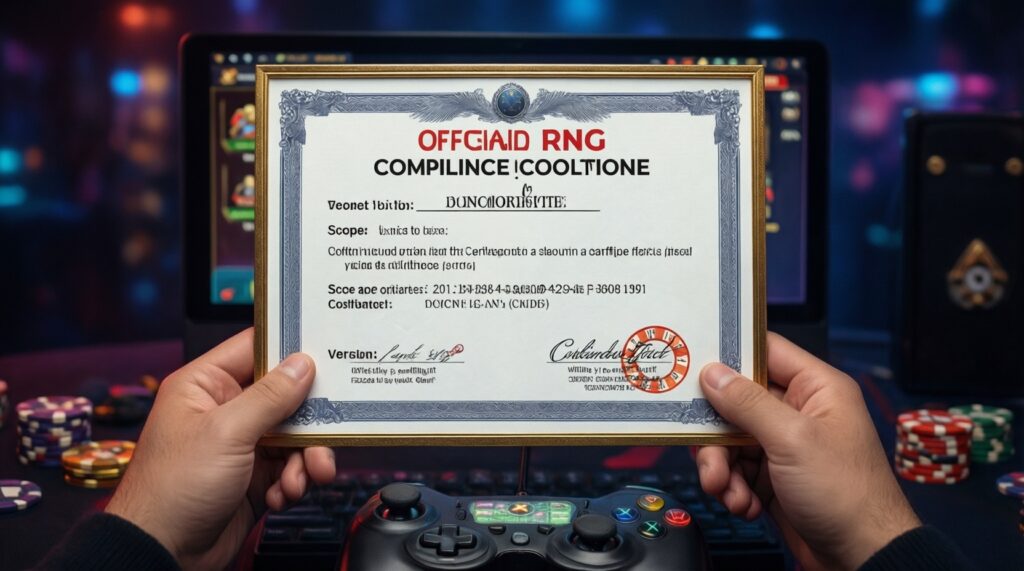
No. A certificate may cover a platform RNG, a specific RNG module, or a set of games; you still need scope and version alignment for the exact title you play.
What should I look for in RNG certification for online casinos?
Lab identity, issue date, explicit scope (RNG and/or game math), and identifiers that tie the report to the provider/game/build and jurisdiction.
Can I reproduce casino RNG testing results at home?
You can run sanity checks on observable outcomes, but you usually can't access raw RNG bitstreams or internal controls. Treat your tests as screening, not as certification-grade proof.
Do streaks or "cold slots" indicate rigging?
Not by themselves. Random processes produce clusters and long streaks naturally; persistent, repeatable bias across controlled samples is a stronger signal.
What evidence is most persuasive in a complaint?
Round IDs, timestamps, game/provider name, game version/build, RTP profile if available, and a brief summary of your method and findings.
What does independent casino game auditing typically validate?
That the RNG and/or game math behaves as specified under controlled conditions, and that processes exist to prevent unauthorized changes. The exact depth depends on the audit scope.