

If your goal is to choose between slots and table games, decide based on three levers: edge (RTP/house edge), variance (how swingy results feel), and the bankroll you can comfortably risk per session. Slots can offer high RTP but usually higher variance; table games offer clearer odds, steadier variance, and easier bankroll control.
Executive summary: how odds, RTP and variance shape your choice
- Odds clarity: table games show probabilities and rules; slots hide probability behind paytables and RNG, which affects slots vs table games odds decisions.
- Edge framing: use house edge = 1 − RTP to compare best RTP slots vs table games on one scale.
- Variance drives stress: online casino slots RTP and variance can still feel brutal even at the same RTP due to big payout dispersion.
- Bankroll control: table games make bankroll management for slots and table games more predictable because bet sizes and outcomes are constrained.
- Skill impact: some table games allow decision quality to reduce edge; slots generally do not (outside of choosing the game and stake sizing).
- Best fit depends on your persona: conservative players usually favor low-volatility table games; recreational players may accept slot volatility for entertainment; advantage-seekers optimize rules, comps, and discipline.
How slot mechanics determine odds and RTP

Use these criteria to evaluate a slot before you put meaningful THB on it. Think of them as a checklist for understanding why two games with similar RTP can feel totally different.
- Published RTP (if available): treat RTP as a long-run average; verify if the provider offers multiple RTP settings and which one the casino uses.
- Volatility/variance rating: high-volatility slots concentrate value into rarer big hits; low-volatility slots return smaller wins more often.
- Hit frequency: how often you get any payout (not profit). Higher hit frequency can still be losing if payouts are small.
- Bonus dependency: if most value is locked in free spins/bonus rounds, bankroll drawdowns between bonuses can be large.
- Max win and tail risk: large max win usually implies a heavier "long tail" and more extreme session swings.
- Bet sizing granularity: fine-grained stakes (e.g., 10-20 steps) let you target a stable "spins per bankroll" plan.
- Feature purchases (buy-bonus): these compress time but increase variance; only use them if your bankroll plan explicitly accounts for it.
- Game pace (spins/hour): faster pace increases expected loss per hour at the same stake; auto-play can quietly accelerate spending.
- Paytable structure: clustered low wins vs rare line hits vs multiplier-heavy mechanics change perceived streakiness even at similar RTP.
Table games: transparent probability and edge analysis
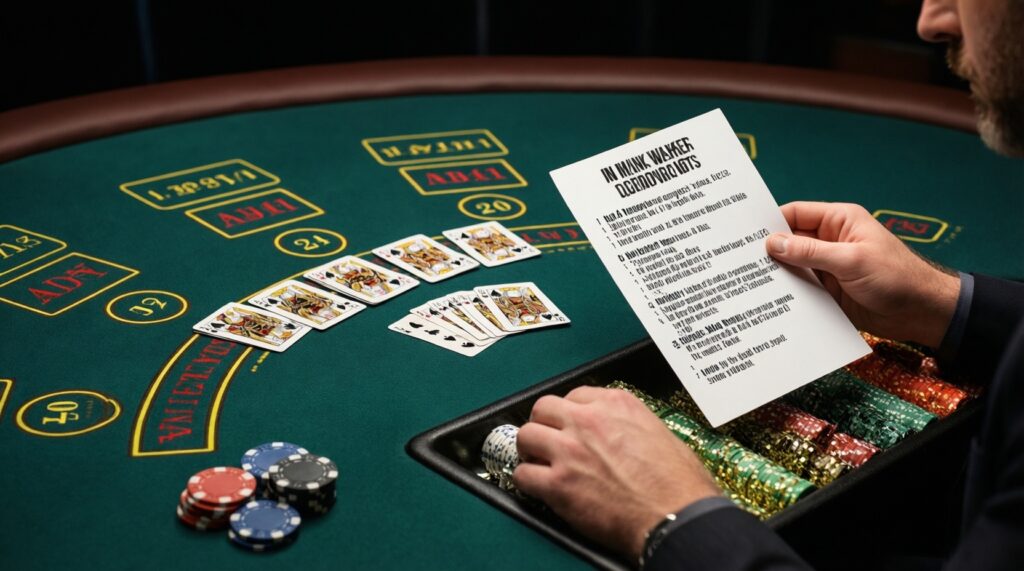
For best table games odds and house edge, focus on rule set, decision quality, and whether the bet is a main wager or a side bet. The "best" option is the one whose edge and variance match your session goal and your discipline.
| Option | Who it fits | Pros | Cons | When to choose |
|---|---|---|---|---|
| Blackjack (main hand, basic strategy) | Intermediate players who can follow a chart consistently | Player decisions matter; pace is controllable; clear rule-based edge | Rule variations can worsen value; errors add hidden cost | When you want a skill component and steady, repeatable bankroll control |
| Baccarat (Banker bet focus) | Conservative to recreational players who want simple execution | Very simple decision process; stable variance vs many alternatives | Commission/house rules vary; side bets are usually expensive | When you want low decision load and consistent bet sizing |
| Roulette (single-zero / European, outside bets) | Recreational players who value simplicity and pacing | Easy to understand; outcomes and odds are transparent | Edge is fixed by wheel type; inside bets increase variance sharply | When you can access single-zero and want simple, paced play |
| Craps (Pass/Don't Pass with odds) | Advantage-seekers and disciplined players who like rule-driven bets | Some bets are structurally better; odds bets can reduce blended edge | Busy layout; social pressure can cause bad side-bet habits | When you can stick to a small set of "core" bets and ignore proposition bets |
| Video poker (full-pay tables) | Intermediate players willing to learn optimal holds | Transparent paytable; decision quality matters; variance is measurable | Paytables vary widely; mistakes can be costly | When you can identify strong paytables and play a fixed strategy |
| Slots (as a "table option" in your allocation) | Recreational players seeking bonuses, themes, and jackpot-style outcomes | Fast, simple, entertaining; potential for large single-hit outcomes | Odds are less transparent; variance can dominate session results | When entertainment value outweighs the need for stable results |
Variance and volatility: what they mean for session outcomes
Use scenario rules like these to choose structure and pacing. They're practical guardrails when your short-term experience diverges from long-run RTP.
- If you want longer sessions with fewer "wipeout" streaks, then prefer lower-variance structures: table games with constrained outcomes (e.g., flat betting) or lower-volatility slots, and avoid side bets and buy-bonus features.
- If you are chasing rare big hits, then accept that high-volatility slots and aggressive table side bets can produce long losing runs; cap the session budget and treat it as entertainment spend.
- If tilt is your main risk, then pick low decision-load games (e.g., baccarat Banker focus) and pre-commit to a fixed stake and stop-loss/stop-win rules.
- If you can execute a strategy reliably, then table games with meaningful decisions (blackjack, video poker) can outperform your own "random play" simply by reducing self-inflicted edge.
- If you notice spending accelerates, then slow the game down (manual pace, fewer hands/spins per hour) because expected hourly loss scales roughly with bet size × decisions per hour.
Bankroll planning formulas for slots versus table games
Use this quick algorithm to decide stake sizing and session limits. All math below is illustrative; plug in your own budget in THB and your chosen bet size.
- Set a hard session bankroll (B): the maximum THB you can lose today without chasing. Write it down.
- Choose a target session length: decide how many spins/hands you want. This prevents "silent overplay."
- Estimate expected loss (EL):
- EL ≈ Total wagered × House edge
- Total wagered = bet size × number of decisions (spins/hands)
- House edge = 1 − RTP (use published RTP if available, otherwise do not assume)
- Pick a unit size from bankroll:
- Conservative: unit = B / 200 to B / 300
- Recreational: unit = B / 100 to B / 200
- Aggressive/high-volatility: unit = B / 50 to B / 100
- Add variance protection:
- For high-volatility slots: reduce unit by 30-50% versus your table-game unit, or shorten session length.
- For table games with side bets: treat side bets as a separate "high-variance budget," not part of the main unit.
- Pre-commit stops:
- Stop-loss: typically 50-100% of B (choose one number, no exceptions).
- Stop-win: pick a level you will actually bank (e.g., +30 to +80 units), then leave.
- After the session, audit one metric: decisions played and average stake. This single habit improves bankroll management for slots and table games more than any "system."
Persona-based recommendations: conservative, recreational, advantage-seeker
Pick the persona closest to how you actually behave (not how you want to behave). Then follow the rules exactly for 3-5 sessions before changing anything.
Persona 1: Conservative bankroll protector
- Primary pick: baccarat (simple main bet) or roulette outside bets on a favorable wheel type; consider blackjack only if you can follow basic strategy without deviation.
- Stake rule: unit = B/250; never raise the unit during the session.
- Session rule: split B into 3 mini-sessions; if one mini-session is lost, pause or stop.
- Avoid: slot buy-bonus, jackpots-as-a-plan, table side bets.
Persona 2: Recreational experience-seeker
- Primary pick: a small, controlled slot allocation plus a simple table-game base (e.g., baccarat or roulette) to stabilize time-on-device.
- Stake rule: tables unit = B/150; slots unit = (tables unit) × 0.6 to reduce volatility drag.
- Entertainment rule: decide in advance: "feature focus" (bonuses) or "time focus" (more spins). Do not mix.
- Watch-outs: fast auto-spin; raising stakes after small wins; treating "near misses" as information.
Persona 3: Advantage-seeker (discipline-first)
- Primary pick: blackjack with strict basic strategy, full-pay video poker where available, or craps with a tight bet menu (core bets only).
- Stake rule: unit = B/200; if you deviate from strategy even once due to emotion, drop unit by 25% next session.
- Process rule: pre-check rules/paytables; refuse negative side-bet temptations. Edge control comes from selection and execution.
- Mindset: evaluate decisions, not outcomes. This is the only sustainable way to compare best RTP slots vs table games in practice.
Common mistakes that derail the choice (and how to prevent them)
- Comparing games only by RTP while ignoring variance; fix by setting a unit size based on volatility.
- Assuming "hot/cold" streaks change odds; fix by using fixed units and fixed session length.
- Mixing low-edge main bets with high-edge side bets; fix by allocating a separate side-bet micro-budget or skipping them.
- Increasing stakes to "recover" after losses; fix by pre-committing to a flat unit per session.
- Playing too fast; fix by targeting a maximum decisions-per-hour for your budget.
- Choosing slots without checking RTP setting/volatility info when available; fix by only playing titles where you can verify basic parameters.
- Switching games mid-session out of boredom; fix by planning a 2-block session (one game only per block).
- Confusing short-term luck with long-term value; fix by tracking total wagered and expected loss.
Practical comparison table: expected loss, session length and risk metrics
For steadier sessions and clearer control, table games usually win on transparency and pacing; for theme-driven fun and occasional big-hit potential, slots can be the better experience. Your best choice comes down to whether you prioritize predictable bankroll burn or excitement per unit of risk.
| Game type (example) | Assumed edge/RTP (example) | Stake & pace (example) | Total wagered (example) | Expected loss (example) | Risk note (variance in plain terms) |
|---|---|---|---|---|---|
| Slot (high volatility) | RTP 96% (edge 4%) | ฿20/spin × 500 spins | ฿10,000 | ฿400 | High swing: outcomes cluster around long losing runs with occasional big wins; bankroll drawdown can be sharp despite same expected loss. |
| Slot (low volatility) | RTP 96% (edge 4%) | ฿20/spin × 500 spins | ฿10,000 | ฿400 | Lower swing: more frequent small returns, but still negative expectation; easier to sustain session length. |
| Table game (flat betting example) | Edge 1.5% (example) | ฿200/hand × 60 hands | ฿12,000 | ฿180 | Moderate swing: individual results vary, but dispersion is usually narrower than high-volatility slots at similar time spent. |
| Table game + side bets | Blended edge 4% (example) | ฿200 main + ฿50 side × 60 hands | ฿15,000 | ฿600 | Hidden swing: side bets can dominate variance and increase loss rate; feels like "action" but burns bankroll faster. |
Quick clarifications on common practical concerns
Is RTP enough to decide between slots and table games?
No. RTP (or house edge) tells long-run expectation, but variance determines how painful the short run feels and whether your bankroll survives the session.
Are slots vs table games odds directly comparable?
Yes if you translate everything into house edge (1 − RTP), but "odds of profit today" will still differ because variance and pace differ.
What is the simplest way to use online casino slots RTP and variance together?
Keep RTP as the expectation metric, then size your slot unit smaller as volatility increases. If volatility is unknown, assume it's high and reduce unit size.
What's the fastest bankroll management rule for slots and table games?
Set a hard session bankroll B, choose a unit (B/200 is a solid default), and never increase the unit mid-session. Control pace to control hourly spend.
Which are the best table games odds and house edge in practice?
Focus on main bets with clear rules and avoid side bets. The specific best choice depends on the rules offered and whether you can execute strategy consistently.
Should I change games after a losing streak?
No. Changing games does not reset probabilities; it often increases spending through faster play and emotional bet sizing.
Do progressive jackpots improve the value of slots?
They can, but only when the jackpot is high enough relative to its contribution to RTP-information players usually cannot verify reliably. Treat jackpots as entertainment, not a plan.