

Live dealer casinos are real-time casino tables streamed from a studio (or casino floor) where a human dealer runs the game and players bet through a UI. To evaluate them practically, focus on studio operations, rule variants that change expected outcomes, and live casino streaming quality-because video, latency, and dispute processes directly affect how confidently you can play.
Snapshot: what matters most in live-dealer ecosystems
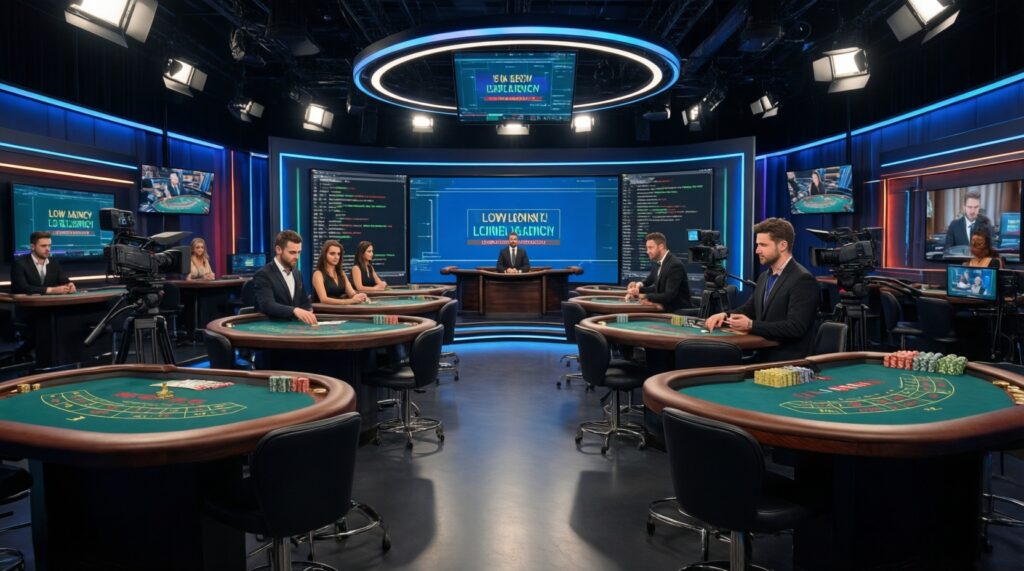
- Studio design determines speed, security, and how reliably outcomes can be verified on camera.
- Rule permutations in live casino games (especially blackjack and roulette) change risk and decision value more than UI features.
- Streaming pipeline choices (encoding, CDN, buffering) control latency and clarity during critical moments.
- Trust comes from measurable quality signals: readable cards/ball track, stable timestamps, and consistent round flow.
- Regulation plus operational controls (logs, incident handling, escalation paths) matters more than branding claims.
Anatomy of a live-dealer studio: layout, equipment and roles
A live-dealer studio is a controlled production environment built to run table games continuously while recording and streaming every action. Unlike RNG-only products, the "system" includes physical dealing, camera framing, audio, game-control software, and human procedures that must stay consistent across shifts.
Typical zones are: the table area (dealer, layout, shuffler/wheel), the capture area (cameras, lighting, microphones), and the control layer (game server, video encoder, monitoring stations). Many studios also have a dedicated pit/ops desk to oversee table integrity and handle player disputes.
Key roles are distinct: dealers run the game; game presenters may speak to camera; floor supervisors watch for procedure deviations; tech operators manage video/audio and table sensors; and support teams handle chat moderation, payment issues, and round-history requests.
- Verify camera coverage includes all decision points (shoe, discard tray, roulette wheel/ball path, dealer hands).
- Confirm there is an independent supervisor function (not only the dealer) monitoring rounds.
- Check the table has clear round boundaries (start/close bets, settle, confirm) visible in UI and on stream.
- Look for a documented dispute path (who reviews, what evidence is used, expected response window).
Game variants and rule permutations that change house edge
In live formats, the biggest practical difference between "tables" is rarely the dealer-it's the rules. A table titled the same way across brands can behave differently because of hit/stand rules, payouts, side bets, and bet limits, which changes decision value and bankroll variance.
- Blackjack payouts: 3:2 vs 6:5 changes the value of naturals; always confirm before playing live dealer blackjack.
- Dealer rules: Stand vs hit on soft totals affects optimal play and expected outcomes.
- Double/split restrictions: Limits on doubling after split, re-splitting, or splitting aces alter strategy options.
- Shoe and shuffle procedure: Continuous shufflers vs shoe penetration affect card-flow patterns; you can't assume the same rhythm table-to-table.
- Roulette wheel variants: Single-zero vs double-zero layouts materially change outcome frequency; this is central when choosing live roulette online.
- Rule add-ons: "En prison", "la partage", or special side bets can shift variance and session volatility.
- Open the table info panel and read payout + dealer-rule lines before the first bet.
- Match your strategy chart to the exact rule set, not the game name.
- Treat side bets as a separate product: evaluate volatility and payout structure independently.
- If rules are unclear on mobile, switch to landscape or desktop before committing bankroll.
Streaming pipeline: codecs, bitrate, CDN and latency sources
The streaming pipeline is the chain from camera capture to your device decode. In practice, it determines whether you see a card clearly before acting, whether bet-close feels predictable, and whether interaction (chat, dealer prompts) stays in sync.
Common applied scenarios:
- Mobile on inconsistent networks: Adaptive bitrate changes resolution mid-hand; you may lose readability at the moment you need it most.
- Cross-border viewing in Thailand: Longer routing to a distant CDN edge can add delay; this is often mistaken for "slow dealer."
- Peak-hour congestion: Higher buffering increases end-to-end latency; bets may close "earlier than expected" relative to what you see.
- Multi-camera switching: Camera cuts can create micro-stutters if encoding profiles differ, affecting confidence in wheel/ball tracking.
- Older devices: Hardware decoding limitations can cause frame drops even if the network is fine.
- Test the same table on Wi‑Fi and mobile data; note latency feel and clarity differences.
- Prioritize stable playback over maximum resolution when making time-sensitive decisions.
- If the UI has a quality selector, lock it when your connection is stable to reduce switching artifacts.
- When comparing best live dealer casinos, compare "time to stable playback" as much as visual sharpness.
Quality metrics that affect player decisions and trust

Players judge trust by what they can verify visually and by how predictable the round flow feels. Operators should treat quality as a measurable product feature: clarity, continuity, and auditability.
Signals that improve confidence and decision-making
- Readability: Cards and roulette outcomes are consistently legible without zooming or guessing.
- Continuity: No missing moments between "close bets" and outcome reveal (no suspicious cuts at critical times).
- Synchronization: UI events (bet close, settle) align with what you see and hear from the dealer.
- Round history coherence: The result log matches the on-camera sequence and timestamps.
Limits and red flags to treat as operational risk
- Frequent rebuffering: You may experience late perception of bet-close and feel rushed.
- Motion blur at key moments: Weakens verifiability (e.g., fast card reveals or roulette ball travel).
- Audio drift: Can indicate broader sync issues; undermines trust in "when" actions occurred.
- Inconsistent dealer procedure: Even with good video, inconsistent dealing increases disputes.
- Use a "one-minute trust test": can you verify every step of one full round without assumptions?
- Pause switching tables until your stream is stable for several consecutive rounds.
- If you rely on visual verification, avoid tables where camera angle hides decision points.
- For live casino streaming quality comparisons, focus on continuity and sync, not only resolution labels.
Regulation, certification and fair-play controls for live games
Fair play in live games is enforced by a mix of licensing requirements, operational controls, and evidence retention. A common mistake is assuming "licensed" automatically means "no disputes" or "perfect stream." Licensing helps, but your practical protection comes from what can be audited and replayed.
- Myth: The video stream is the only evidence. In reality, disputes often use a combination of video, game server logs, and table event records; if any are missing, resolution becomes harder.
- Mistake: Ignoring rule disclosure and bet-close behavior. Many complaints come from not understanding when bets lock versus when the player sees it due to latency.
- Myth: A famous brand guarantees identical rules everywhere. Table configurations differ by jurisdiction, studio, and provider.
- Mistake: Treating side bets as "standard." Side-bet structures vary widely and can amplify variance and dispute frequency (mis-clicks, misunderstood payouts).
- Myth: Live means immune to technical faults. Camera drops, encoder restarts, and UI desync can still happen; the key is how incidents are logged and corrected.
- Look for clear table rules + an accessible round history feature before playing.
- Prefer platforms that explain dispute evidence (video + logs) and escalation steps.
- Be cautious if the UI cannot show the exact moment bets close relative to the round.
- Document issues immediately (table name, round ID, timestamp) to support resolution.
Operational best practices: uptime, monitoring and dispute handling
Operational maturity shows up as predictable round flow, quick recovery from incidents, and consistent support outcomes. Below is a practical "operator view" flow that also helps players understand what should happen when something goes wrong during live casino games.
// Minimal incident workflow (conceptual)
onStreamAnomaly(tableId):
  markIncident(tableId, timeNow, symptom)
  captureEvidence(videoSegmentId, roundId, serverLogRef)
  if outcomeIntegrityUnclear:
    pauseTable(tableId)
    notifySupervisorAndSupport(tableId)
    reconcile(roundHistory, video, dealerProcedure)
    decide: voidRound | re-settle | continue
  publishStatusToPlayers(tableId, conciseReason)
  closeIncidentWithRCA(tableId)
Mini-case: a player reports that the UI showed "bet accepted" but the round settled as "late bet." The correct process is to reconcile the acceptance timestamp, bet-close event, and stream latency characteristics-then explain the result using round ID and event times, not generic statements.
- Players: always record table name + round ID when something feels off.
- Operators: correlate player-facing UI events with server events; don't rely on video alone.
- Ensure support has a clear escalation path to the studio supervisor for live dealer blackjack and roulette disputes.
- After fixes, validate by observing multiple rounds for sync and bet-close consistency.
Self-check before you choose a table or provider
- Can you read outcomes reliably on your device without relying on UI labels?
- Do the posted rules match the strategy you intend to use (especially payouts and dealer rules)?
- Is the round flow predictable despite your network conditions in Thailand?
- If a dispute happens, do you know what evidence exists (round ID, logs, replay) and who reviews it?
- Have you compared at least two tables for latency feel, not just visuals?
Practical concerns players and operators commonly raise
How do I compare best live dealer casinos without relying on marketing claims?
Compare rule sheets, round-history transparency, and how stable the stream stays over several rounds on your connection. If you cannot verify outcomes clearly, treat it as higher operational risk.
Why does the same live roulette online table feel faster or slower across brands?
Perceived speed often comes from latency and buffering, not dealer pace. Different CDNs, encoding settings, and bet-close timers can make the same physical procedure feel different.
What should I check first when starting live dealer blackjack at a new table?
Confirm the blackjack payout, dealer soft-total rule, and any restrictions on doubling/splitting. Then watch one full round to see camera coverage of the shoe, dealer hands, and discard process.
Does higher resolution always mean better live casino streaming quality?
No-continuity and sync matter more for trust. A slightly lower resolution with stable playback is often safer than frequent bitrate switches and rebuffering.
How can I reduce mis-clicks or late bets in live casino games?
Bet earlier in the countdown, avoid switching apps during a round, and use a stable network. If latency is noticeable, treat the displayed countdown as optimistic and act sooner.
What evidence helps resolve a disputed result?
The most useful items are table name, round ID, approximate local time, and a description of what you saw versus what settled. Operators typically reconcile video segments with server event logs and round history.