

A high-quality live dealer casino stream is defined by stable video/audio with low latency, clear table procedure, verifiable dealing/shuffling, and a security and oversight trail that holds up in disputes. Most player-facing problems come from weak network delivery, unclear UI signals, and incomplete transparency-issues you can detect and prevent quickly with a few checks.
Core criteria for top live-dealer streams
- Consistent stream delivery (no repeated buffering, stable resolution, predictable latency).
- Readable table state (cards/ball outcomes, betting windows, and dealer actions are unambiguous).
- Transparent procedure (shoe changes, shuffles, spins, and pays are observable and announced).
- Verifiable fairness controls (camera coverage, result capture, and clearly stated rules on edge cases).
- Hardened account and session security (encryption, anti-fraud signals, and clean device/session hygiene).
- Operational accountability (licensing, audits, and a practical dispute path with retrievable logs).
Technical standards: video quality, audio fidelity and latency thresholds
In live dealer, "quality" is not about cinematic visuals-it's about continuity and clarity. You should be able to track the full sequence of actions (bets open → no more bets → deal/spin → settlement) without dropped frames, audio desync, or UI delays that make outcomes feel ambiguous.
Practical targets for an intermediate evaluation are: stable 720p+ rendering, consistent frame pacing (commonly 25-30 fps), and end-to-end interaction latency that stays low enough to avoid "bet accepted" uncertainty (often felt above ~800-1200 ms, depending on device and network). On mobile networks in Thailand, the biggest risk is jitter (latency swings), not raw bandwidth.
Audio matters because it acts as a procedural timestamp: dealer callouts and table prompts should align with what you see. If voice is delayed or repeatedly cuts, you lose the ability to verify the order of events-especially in live roulette casino rounds where the "no more bets" moment is critical.
| What you notice | Likely cause | Fast prevention / fix |
|---|---|---|
| Outcome appears before the physical action is visible | UI is ahead of video (desync) or aggressive buffering strategy | Switch camera quality to "Auto" off; restart stream; prefer Wi‑Fi over congested mobile; close background video apps |
| Frequent "reconnecting" during betting window | Jitter spikes or packet loss | Move closer to router; disable VPN/proxy; switch DNS only if needed; test a second network before playing real money |
| Dealer voice is choppy, but video is fine | Audio channel prioritization issues or device audio stack conflicts | Toggle sound off/on; change browser; disable Bluetooth audio; avoid low-power mode during sessions |
| Touch/click delay causes mis-bets | Client rendering lag or overloaded device | Reduce animations; close other tabs; use native app if it's lighter; avoid battery saver |
Dealer conduct: training, table procedure and transparency
Dealer conduct is the human layer that turns a video feed into a reliable game process. The best operators standardize how dealers announce steps, handle mistakes, and present the table to cameras, so you can audit the round with your own eyes-especially in live casino blackjack where the card sequence and hand signals matter.
- Pre-round clarity: dealer confirms table limits, side bets, and when betting opens/closes.
- Camera discipline: hands remain in view during dealing; key actions happen in the primary camera zone.
- Consistent callouts: "No more bets" and result announcements match the visible action timing.
- Error protocol: mis-deals, exposed cards, or unclear roulette outcomes trigger a documented procedure (pause, supervisor check, re-round rules) rather than ad-hoc decisions.
- Shuffling/shoe changes: performed at defined times, announced, and kept on camera.
- Player communication: short, procedural responses; no coaching, no suggestive prompts, no pressure tactics around a live dealer casino bonus.
Ensuring fairness: shuffling, card/ball traceability and RNG interaction
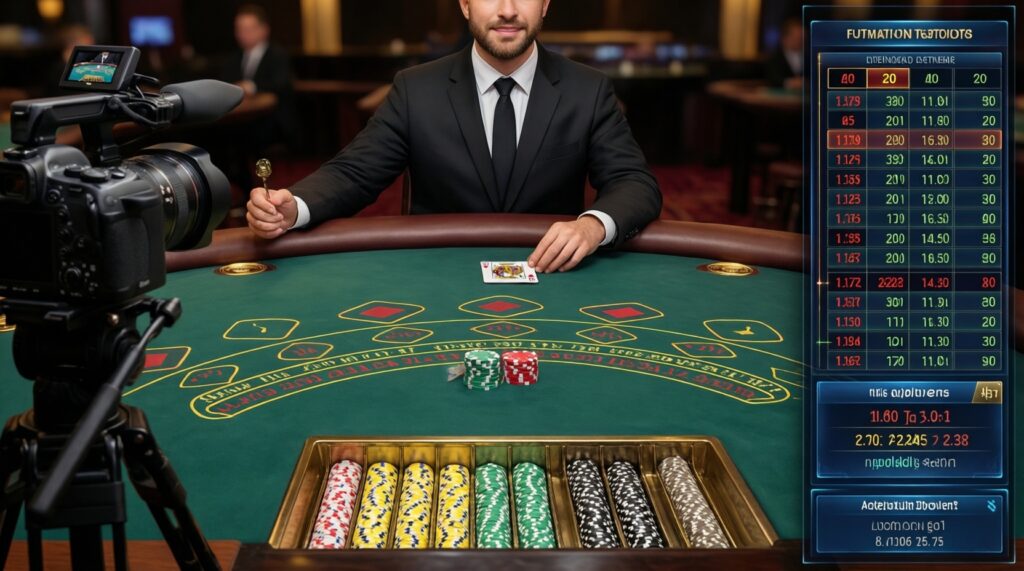
Fairness in live dealer is primarily observational: you can see the physical process. Where players get confused is the "hybrid" layer-digital systems that time the betting window, capture results, and settle wagers. Typical real-world scenarios where fairness controls matter most:
- Blackjack shoe entry and mid-shoe changes: you should see the shoe, cut card handling (if used), and when the shoe is replaced.
- Roulette spin outcomes: the ball drop and final pocket should be visible; if a sensor confirms the number, the operator should explain how disputes are handled when video is unclear.
- Game-show style wheels: the spin must be fully shown; outcome capture should be consistent (no "jump" cuts at the stop).
- Side bets and multipliers: rules must state how side bets settle if the stream drops mid-round.
- RNG interaction (when present): some products blend live elements with RNG-driven bonuses; it should be clearly labeled so you know what is physical and what is randomized digitally.
Security stack: encryption, anti-fraud systems and data handling
Security determines whether a real money live dealer casino experience stays fair at the account/session level. A great stream can still be a bad product if logins, payments, or session integrity are weak.
Benefits when the stack is implemented well
- Transport protection: TLS-encrypted sessions reduce interception risks on shared networks (common in cafés and condos).
- Session integrity: device/session binding and anomaly detection reduce account takeover and bot-driven bonus abuse.
- Fraud friction where it matters: step-up verification on risky events (new device, unusual cashout pattern) without breaking normal gameplay.
- Dispute-ready logs: round IDs, timestamps, and settlement records are consistent across wallet, game server, and video archive references.
Limits and common gaps to watch
- Encryption doesn't fix latency: if your network is unstable, you still risk mis-clicks and timing confusion; test first before higher stakes.
- Anti-fraud can misfire: aggressive rules may freeze withdrawals; keep your KYC data consistent and avoid VPN hopping.
- Data handling opacity: if the operator can't explain what gets stored (device IDs, session logs) and for what purpose, disputes become harder.
- Bonus-driven risk: a live dealer casino bonus can add wagering constraints; if terms are unclear, the "security" team may treat normal play as abuse.
Product design: UI, multi-camera views and player controls
Many players assume "best live dealer casino" means the dealer is charismatic or the studio looks premium. In practice, the most damaging issues are product design mistakes that hide state changes or encourage rushed bets.
- Mistake: betting-state ambiguity. If "bets accepted" and "no more bets" are subtle, latency feels like unfairness. Prevention: demand clear countdowns and a visible bet confirmation state.
- Mistake: camera switching that cuts critical actions. Multi-camera is only helpful if the main camera always shows the decisive action. Prevention: use a fixed primary view during outcomes; offer picture-in-picture only as optional.
- Myth: higher resolution always improves fairness. 1080p with buffering is worse than stable 720p where actions are continuous. Prevention: prioritize stability over max quality.
- Mistake: overloaded UI on mobile. Dense side bets and animations increase mis-taps. Prevention: provide a "simple mode" and larger tap targets.
- Myth: bonuses compensate for weak UX. A live dealer casino bonus can't fix mis-bets, desync, or unclear rules; it often increases pressure to play through issues. Prevention: validate the stream and controls before opting into promotions.
Quick prevention checklist (player and operator)
- Run a 2-3 minute "no-bet" observation: verify round pacing, audio sync, and camera coverage.
- Lock a stable quality profile (avoid constant auto-switching if it causes jumps); prioritize fewer stalls over higher resolution.
- Confirm UI states: countdown, "bet accepted," "no more bets," and settlement should be unmistakable.
- Check rule visibility: mis-deal/invalid spin policy, disconnect policy, and side-bet settlement rules.
- Test one low-stake round before scaling stakes or starting a wagering requirement.
- Keep sessions clean: no VPN hopping, no background downloads, and one account per player.
Oversight: licensing, independent audits and dispute resolution
A fair experience needs a path for escalation when something goes wrong: you need round identifiers, a consistent timeline, and a human-readable decision trail. Before committing meaningful stakes, confirm the operator shows licensing details and a dispute channel that can reference specific rounds.
Mini-case: resolving a "late bet" complaint with round evidence
Given: round_id, client_timestamp, server_timestamp, video_marker

1) Player exports bet receipt (round_id, amount, client_timestamp).
2) Operator checks server log for "bet_accepted" event:
   - if bet_accepted_time <= betting_close_time: valid bet
   - else: invalid bet (refund per rule)
3) Operator aligns video_marker to betting_close announcement:
   - confirm whether UI desync occurred (video vs UI timeline)
4) Decision is issued with:
   - round_id
   - close_time
   - accepted/rejected rationale
   - next step for escalation
Practical player queries on live-dealer quality
How can I tell if a stream is "good enough" before I bet?
Watch 2-3 minutes with no bets: check for repeated buffering, audio/video sync, and whether the "no more bets" moment is clear. If the UI jumps ahead of the physical action, don't play.
Does higher video quality (1080p) mean a fairer game?
No-fairness depends on continuity and visibility of key actions. A stable 720p stream that never stalls is usually safer than a 1080p stream that skips during critical moments.
Is live casino blackjack easier to verify than roulette?
Blackjack is often easier because the card sequence and hand procedures are more auditable on camera. Roulette can be harder if the final pocket isn't consistently visible at the moment the result is captured.
What should I check before accepting a live dealer casino bonus?
Confirm the game contributes as expected to wagering, and read the disconnect and void-round rules. Test a low-stake round first to ensure your stream and UI timing are stable.
Why do I sometimes feel my bet was "late" even though I clicked in time?
It's usually latency or jitter combined with unclear UI confirmation. If you don't see an explicit "bet accepted" state before closure, assume it may not count.
What's the fastest way to compare a few rooms to find the best live dealer casino for me?
Compare one table per provider on the same device and network: stability, UI clarity, and dispute-ready receipts (round ID, timestamp) matter more than studio aesthetics.
Is a real money live dealer casino safe on public Wi‑Fi?
It's riskier because of shared-network threats and instability. Use trusted Wi‑Fi or mobile data, avoid VPN hopping, and enable strong account security before depositing.