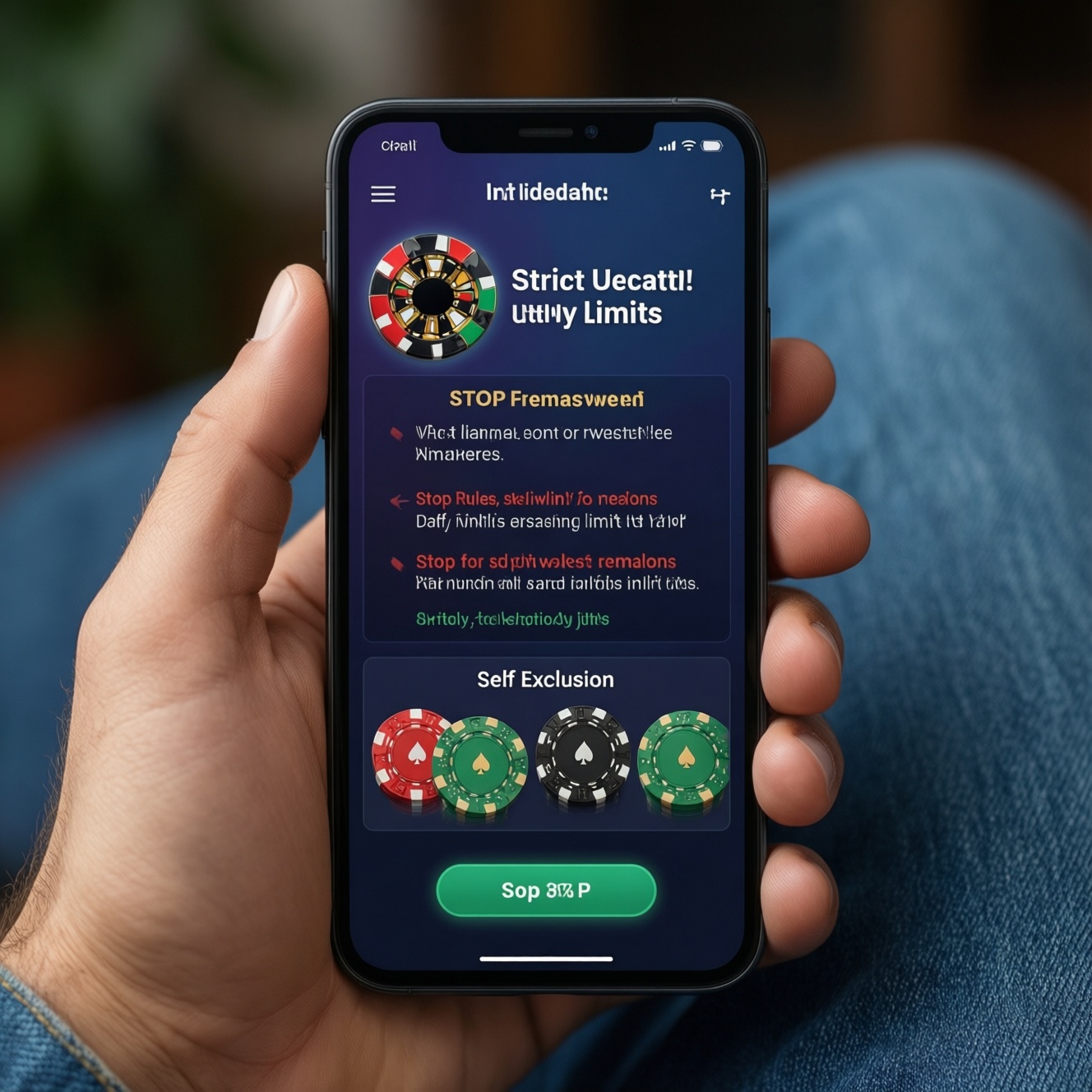
Responsible gambling means using clear limits, tracking, and pre-committed stop rules so gambling stays within time and money you can afford to lose. Use responsible gambling tools (site limits, reality checks, blocks), set gambling limits before you play, and escalate quickly to gambling self exclusion or problem gambling help if you notice repeated loss of control.
Immediate self-checks to verify you're in control
- You can stop at a pre-set time even after a win or a loss.
- You know today's maximum spend and you are staying below it (no "one more deposit").
- Gambling is not used to fix mood, stress, or financial pressure.
- You are not hiding play, lying about spending, or deleting messages/transactions.
- You can take a full day off without strong urges, irritability, or chasing thoughts.
- Your essentials (rent, bills, food, savings) are protected by separation from gambling funds.
Recognising early warning signs of slipping control
This is for anyone who gambles online or offline and wants a practical early-warning system. It is especially useful if you have started increasing stakes, sessions, or deposits, or if gambling is becoming a default activity.
Do not rely on self-checks alone if you are gambling with borrowed money, using gambling to cope with distress, or feeling unable to stop once you start. In those cases, skip ahead to external support and consider gambling self exclusion immediately.
- Chasing: increasing bets or extending sessions to "get back" losses.
- Time drift: sessions routinely run longer than planned, especially late at night.
- Budget leakage: small extra deposits that add up, or moving money between accounts.
- Secrecy: hiding receipts, playing in private, clearing browser/app history to avoid questions.
- Mood dependence: gambling to escape stress, boredom, loneliness, or frustration.
- Functional cost: missed work, poor sleep, skipped meals, conflict with family/partner.
Quantifiable tracking: time, spending and mood indicators
You only need a simple tracking setup that you will actually use. The goal is to make "out of control" measurable, not debatable.
- One place to log: notes app, spreadsheet, or paper card kept with your wallet.
- Access to statements: bank/ewallet history and gambling site transaction logs.
- Timer support: phone alarm, calendar blocks, or built-in session reminders.
- Account features: deposit limits, time limits, loss limits, reality checks (if the site offers them).
Simple 60-second tracking template
- Start time / planned end time (e.g., 20:00-20:45)
- Bankroll for today (money you can afford to lose)
- Net result (win/loss at end of session)
- Mood before and after (0-10)
- Trigger (bored, stressed, social, promo, alcohol, etc.)
- Rule breaks (yes/no + which rule)
On-the-spot interventions to pause or stop gambling
-
Call a 2-minute timeout (no debate)
Pause immediately when you notice chasing, irritation, or "just one more" thinking. A short interruption breaks the automatic loop and gives you a chance to follow your plan.
- Stand up, drink water, and move to a different room.
- Set a timer for 2 minutes; no gambling actions during the timer.
-
Run the "3 numbers" check: time, spend, mood
Look at your planned end time, today's maximum spend, and your mood score. If any one is past the limit, you stop-no exceptions.
- Time: Am I past my planned stop time?
- Spend: Am I near or above my daily limit?
- Mood: Am I gambling to fix a feeling?
-
Switch to a "no-more-money" mode
If you choose to continue within limits, remove funding pathways first. This prevents impulsive top-ups and makes the next decision slower and more deliberate.
- Log out of payment apps; remove stored cards from gambling accounts where possible.
- Turn off one-click deposits and disable auto-fill for payment details.
-
Use responsible gambling tools before willpower
Apply site/app controls while you are calm enough to do it. Tools are most effective when set in advance, but using them mid-session is still better than relying on self-control alone.
- Enable reality checks and session time reminders.
- Set or lower deposit limits and time limits right now.
- If you're repeatedly breaking limits, start gambling self exclusion.
-
Exit with a scripted close
Close the session using a fixed script so you don't negotiate with yourself. Record one line in your log, then switch to a replacement activity for at least 20 minutes.
- Script: "Session ended. My next step is: shower / walk / call a friend / meal."
- Log: time stopped + net result + one trigger you noticed.
-
Escalate immediately after repeated rule breaks
If you break a rule twice in a week (or twice in a day), treat it as a system failure, not a motivation issue. Move to stronger barriers and get problem gambling help.
Fast-track mode: 3-5 steps when you feel yourself spiralling
- Stop play for 2 minutes and leave the screen.
- Check: planned stop time, daily spend limit, mood score; if any limit is crossed, end the session.
- Turn on limits or lower them immediately; disable easy deposits.
- Log one line (time stopped + spend + trigger) and do a 20-minute replacement activity.
- If you broke a rule again, start gambling self exclusion and contact problem gambling help.
Designing binding limits: deposit, wager and time rules
Limits work when they are specific, pre-committed, and hard to override. Write them down, apply them in your account settings, and align them with your real cashflow (not your "best case" week).
Limit-setting checklist to confirm it's actually binding
- I have a daily or weekly deposit cap set inside the platform (not only in my head).
- I have a time cap (session length and/or a hard stop time of day).
- I have a loss limit that ends play for the day when reached.
- I have a no-chasing rule: no increasing stakes to recover losses.
- I have a no-top-up rule: no additional deposits after the first deposit of the day.
- I have protected essentials: gambling funds are separated from bill/rent money.
- I have rest days scheduled (at least one non-gambling day each week).
- I have a cooling-off option ready (temporary break) if urges rise.
- I know the exact step to start gambling self exclusion if I break limits repeatedly.
Example of clear rules you can copy
- Time: "I play only between 19:30-20:15. One session max."
- Money: "One deposit per day. No additional deposits, no borrowing, no transferring from savings."
- Stop condition: "If I feel the urge to chase, I end the session immediately."
Leveraging tech: apps, site features and automation
Technology can reduce friction for stopping and increase friction for impulsive deposits. Most failures come from setting weak controls, setting them too late, or leaving workarounds open.
- Setting limits that are so high they never activate (limits should be felt).
- Only setting a deposit limit but not a time limit (you can still lose control on time).
- Relying on "cooling-off" but returning immediately without changing rules.
- Keeping cards saved and one-click deposits enabled.
- Not turning on reality checks/session reminders (you lose track faster than you think).
- Using multiple sites/apps so limits on one account don't matter.
- Tracking only wins/losses but not time and mood (you miss the trigger pattern).
- Trying to "outsmart" blocks instead of strengthening them (a sign to escalate).
- Ignoring device-level protections (screen time, app blockers) when site tools are weak.
Practical responsible gambling tools to combine
- Platform controls: deposit/loss/time limits, reality checks, cooling-off, gambling self exclusion.
- Device controls: screen time limits, app/site blockers, focus modes during high-risk hours.
- Money friction: separate account for entertainment funds; remove stored cards; disable fast deposits.
- Social friction: accountability message to a trusted person when you end a session.
Escalation pathway: when and how to get external help
If self-checks and limits don't hold, move to stronger protection. Escalation is not a moral step; it's an engineering step-adding barriers when the current system fails.
- Cooling-off / short break (useful when urges rise but you can still follow rules): take a time-limited break and use the time to rewrite limits and remove payment shortcuts.
- Gambling self exclusion (useful when you repeatedly override limits or use multiple sites): exclude for a meaningful period and combine it with device blocks and money separation.
- Problem gambling help (useful when gambling affects sleep, relationships, work, or finances): talk to a qualified service or counselor and share your tracking log to speed up assessment.
- Gambling addiction treatment (useful when you feel unable to stop, experience withdrawal-like agitation, or keep returning despite harm): seek structured treatment; bring a clear timeline of patterns, triggers, and attempted limits.
Practical questions users ask and precise answers
How do I know whether I need stronger controls than simple limits?
If you repeatedly break your own rules, hide play, or chase losses, you need stronger barriers like account restrictions, device blocks, or gambling self exclusion.
What are the most effective responsible gambling tools to start with today?
Start with a deposit limit, a session time limit with reality checks, and removal of stored payment methods. Combine these with a simple log of time/spend/mood.
How should I set gambling limits so they actually work?

Set them before you play, keep them specific (time, money, stop conditions), and make them hard to override using in-account limit settings and payment friction.
Is gambling self exclusion only for severe cases?
No. Gambling self exclusion is appropriate whenever you can't reliably stop, keep opening new sessions, or find yourself bypassing softer controls.
What should I do right after a big win to avoid giving it back?

End the session at once, log the result, and lock in a cooling-off period. Avoid "celebration bets," which often trigger longer sessions and higher stakes.
Where do I look for problem gambling help if I'm in Thailand?
Start with local mental health services, hospital-based psychiatry/psychology clinics, or a licensed counselor, and bring your tracking notes. If you feel unsafe or overwhelmed, seek urgent support through local emergency services.
When does it make sense to seek gambling addiction treatment instead of self-management?
Seek gambling addiction treatment when you feel unable to stop, gambling causes repeated harm, or you relapse quickly after trying limits, cooling-off, or self exclusion.