

To judge whether an online casino is fair, you need two parallel checks: (1) RNG evidence (statistical behavior, lab scope, and reproducible test artifacts) and (2) operational integrity for live dealer games (control points, camera/stream controls, and game logs). This guide shows safe, practical steps for an online casino certification check without needing insider access.
Essential indicators of fairness and integrity

- Independent lab report matches the exact product/version in use (game ID, RNG build, platform scope).
- Certificate is verifiable on the lab's site (report ID, date, and status are consistent, not just a logo).
- RNG output behaves like expected distributions across large samples, without suspicious patterns.
- Live games show verifiable control points (shuffles, shoe changes, cut-card use, wheel zeroing, stream continuity).
- Tamper-evident artifacts exist (hashes, digital signatures, or signed PDFs) and are internally consistent.
- Clear escalation path exists (operator compliance contact, regulator complaint channel, lab dispute process).
RNG fundamentals: expected distributions and entropy measures
This section fits intermediate users who can export game histories or capture enough outcomes to run basic statistical checks. It is useful for spotting obvious bias or implementation mistakes and for sanity-checking what a lab report claims.
Don't do this if you cannot obtain clean, sufficiently large samples (e.g., only a handful of spins/hands), if the game has stateful mechanics you can't model (some bonus features), or if you plan to "prove" cheating from a single outlier streak. RNG testing is probabilistic: you look for repeatable anomalies, not one-off losses.
At a high level, fairness in RNG games means outcomes match their documented probabilities and show no predictable structure. For example:
- Expected distributions: roulette results should approximate uniformity across numbers over time; slot symbol frequencies should align with the game's paytable math (usually only labs can confirm exact reel mapping).
- Independence: previous outcomes should not help predict the next beyond chance.
- Entropy/complexity: output sequences should not be compressible or obviously patterned when sampled at scale.
RNG testing methods: chi-square, Kolmogorov-Smirnov, dieharder and beyond
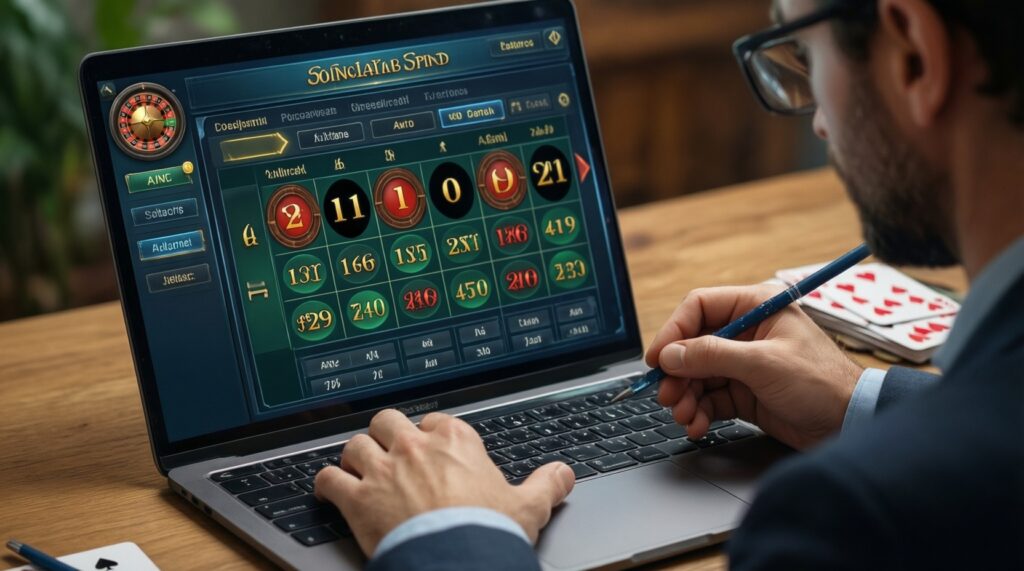
For practical RNG testing for online casinos, you typically need repeatable data capture plus a small toolchain. The goal is to test outcomes you can observe (spins, cards dealt, dice) rather than claiming access to the internal RNG seed.
What you need (tools, access, and data)
- Data source: downloadable game history, session logs, or manually recorded outcomes (timestamped). API access is rare; don't rely on it.
- Normalization rules: a clear mapping from what you record to numeric categories (e.g., roulette number 0-36; baccarat banker/player/tie plus side bets if tested).
- Sample hygiene: avoid mixing game variants (different RTP versions, tables, bet limits) in one dataset.
- Analysis environment: Python/R for chi-square and KS; or command-line tooling for broader suites.
- Optional: dieharder or similar batteries when you can collect long raw-like sequences (often hard for casino games because you observe transformed outcomes, not RNG bits).
Compact comparison: common tests, tools, and what they detect
| Test / tool | Best for | Detects | Typical input you can collect | Limitations (risk-aware) |
|---|---|---|---|---|
| Chi-square (χ²) | Discrete outcomes | Bias in category frequencies | Roulette numbers, baccarat outcomes, blackjack dealer upcards | Needs correct expected probabilities; large samples; multiple comparisons can create false alarms. |
| Kolmogorov-Smirnov (KS) | Continuous or ordered distributions | Distribution shape mismatch | Time-between-events (rare), ordered metrics you can justify | Many casino outcomes are discrete; misuse is common if you force-fit categories. |
| Runs / autocorrelation checks | Independence sanity checks | Clustering, streak structure beyond expectation | Win/loss sequences, red/black, high/low | Streaks happen naturally; interpret only across many sessions and segments. |
| Dieharder (battery) | Raw RNG-like streams | Broad statistical weaknesses | Long numeric streams derived from outcomes (limited) | Transforming outcomes into "random bits" can invalidate results; pass/fail is not definitive proof. |
| Test vectors / reproducibility checks (from labs) | Implementation verification | RNG algorithm implemented as specified | Lab-provided seeds/expected outputs (if disclosed) | Usually not publicly available; depends on what the lab publishes and what the operator shares. |
If you're comparing providers, "casino fairness audit services" usually means the lab has performed controlled testing under access you do not have. Your role as a user is to validate that the operator's claims match a real, in-scope, current report.
Live dealer integrity: source of randomness, control points and camera/stream audits
Risks and limitations (read before you start):
- As a player, you cannot fully audit dealing procedures or backend game control systems; you can only verify observable controls and documentation.
- Stream glitches, camera cuts, and table changes can be normal operations; treat them as risk signals only when recurring or unexplained.
- "Provably fair" concepts generally apply to crypto-style games, not classic live dealer tables; don't expect cryptographic proofs.
- Recording and storing session evidence may be restricted by site terms or local rules; keep it to personal documentation and avoid redistributing streams.
-
Identify the randomness source for the specific live game
Different live games rely on different randomness sources: physical cards (shoe) for blackjack/baccarat, a physical wheel for roulette, or a hybrid "random number determines outcome" game presented with dealers. Your live dealer casino integrity verification starts by classifying which one you're watching.
- Look for table info panels: "from shoe", "from wheel", or "RNG-determined" style wording.
- Note the studio/provider name; integrity controls are often provider-specific.
-
Check observable control points during play
Watch for procedures that reduce manipulation opportunities: shoe changes, cut-card placement, burn cards where applicable, wheel zeroing, and consistent dealing pace. Consistency matters more than a single perfect sequence.
- Roulette: stable wheel speed, no suspicious hand movements near the wheel during spins, and consistent camera framing when the ball is released and lands.
- Card games: visible shoe, clear discard tray handling, and announced or visible shoe swaps.
-
Assess camera/stream continuity and metadata
Integrity relies on uninterrupted visibility at key moments. Brief overlays are normal, but repeated camera cuts right before result resolution are a red flag to document.
- Document timestamps for: pre-spin release, ball landing, card draw, and settlement moment.
- Note any "reconnect" events and whether the game is voided/refunded transparently.
-
Validate game logs and history against what you saw
Open the round history and compare it to your observed outcomes for several rounds. Mismatches (wrong number, wrong card outcome, missing rounds) should be treated as high priority.
- Save round IDs where available; they are essential for disputes.
- Cross-check bet settlement rules shown in the UI against the recorded result.
-
Confirm provider audits and certification are current and in-scope
Live dealer studios may have their own certifications separate from the casino brand. Perform an online casino certification check for both the casino (operator) and the live provider if named.
- Look for a lab name, report ID, and date-avoid relying on "certified" badges alone.
- Where applicable, verify whether the claim is about RNG games, live games, or both.
Reading audit reports: what certificates, signatures and test vectors mean

- Lab identity is verifiable: the report links to a real lab site and uses consistent branding/contact details (not a generic PDF with no traceable origin).
- Scope matches your use case: it explicitly covers the game type (RNG slots vs live tables), platform (web/mobile), and jurisdiction if stated.
- Versioning is explicit: game/build identifiers, RNG module version, or platform release references are present; outdated versions are a common mismatch.
- Report ID and date are consistent: IDs in the certificate, report body, and any verification portal match.
- Tamper evidence exists: digital signature, certificate chain, or a published hash for the report file (and it validates).
- Methodology is named: references to statistical suites (e.g., chi-square) or batteries, and what was tested (outcomes vs raw RNG output) are stated.
- Pass criteria are described: you can see what "pass" means in context, not just a one-line "approved".
- Exceptions are disclosed: limitations, excluded game features, or conditional approvals are clearly written.
- Test vectors (if present) are interpretable: they include input/expected output pairs and identify the algorithm/module they validate.
Step-by-step verification: practical checklist to confirm certification and lab credibility
- Assuming a logo equals proof: "eCOGRA certified casinos" claims should be validated by a certificate lookup or verification page, not by a footer badge alone.
- Not checking scope: a certificate for RNG slots does not automatically cover live dealer tables or a specific game provider.
- Ignoring versions and dates: a valid lab name with an expired or pre-update report can be effectively irrelevant.
- Mixing datasets: running chi-square on combined outcomes from different tables/variants can create false anomalies.
- Over-interpreting p-values: a "significant" result can happen by chance when you run many tests; require repeatability and triangulate with other evidence.
- Testing the wrong variable: slots and many casino games transform RNG internally; player-visible outcomes may not map cleanly to equal-probability categories.
- Not retaining artifacts: without round IDs, timestamps, screenshots, and the exact game/table name, disputes become non-actionable.
- Confusing operator vs provider certification: the casino may be audited, but the embedded live studio may have different controls and certification status.
- Trusting unofficial mirrors: only accept verification pages hosted by the lab/regulator, not re-uploaded PDFs on forums or link shorteners.
Risk mitigation: detecting anomalies, collecting evidence and escalation paths
If you see repeated inconsistencies or can't validate certification, use safer alternatives that reduce exposure while you investigate:
- Switch to games with stronger transparency: prefer titles where you can export detailed histories and round IDs, making anomaly detection and disputes feasible.
- Reduce stakes and segment sessions: smaller bet sizes and shorter sessions make it easier to isolate issues by table/game version and to avoid compounding losses during uncertainty.
- Escalate with a documented package: include round IDs, timestamps, screenshots, and a short description of the mismatch; ask the operator to reference their lab report and scope.
- Use regulated channels when available: if the casino presents a license/regulator, file a complaint with the regulator and attach your evidence; this is more effective than social posts.
Typical concerns about certification, audits and live-dealer trust
Can I personally prove an RNG is fair with public data?
You can detect obvious bias or inconsistencies, but you cannot fully validate the internal RNG implementation without lab access. Treat your results as risk signals and corroborate with current third-party certification.
What is the most practical "RNG testing for online casinos" approach for players?
Collect a clean dataset from one game/version and run simple frequency and independence checks, then compare your findings against the operator's stated math and audit scope. If you cannot obtain enough outcomes, focus on certification verification instead.
How do I validate "casino fairness audit services" claims on a casino website?
Find the lab name, report ID, scope, and date, then verify them on the lab's official verification channel if available. If the site only shows a badge without traceable details, treat it as unverified marketing.
What should I look for in "live dealer casino integrity verification"?
Prioritize stream continuity at key moments, visible control procedures (shoe changes, wheel handling), and consistency between on-screen results and round history. Repeated camera cuts before outcomes or mismatched history entries are high-risk indicators.
What does an "online casino certification check" actually confirm?
It confirms that a specific operator/product version was tested within a defined scope and time period by a named lab. It does not guarantee you will win, and it may not cover every game provider or live table.
Are "eCOGRA certified casinos" always safe to play?
Certification can be a positive signal, but you still need to confirm it is current, in-scope for the games you play, and verifiable through official channels. Also check whether live dealer products are covered or audited separately.