

KYC verification is the identity and compliance check most financial and regulated platforms use before letting you deposit, withdraw, or raise limits. To pass quickly, prepare clear identity verification documents, a matching proof of address, and any source-of-funds evidence your profile may trigger. Follow the same KYC process verification flow each time and avoid common upload mistakes.
Essential checklist: documents, timelines and risk flags
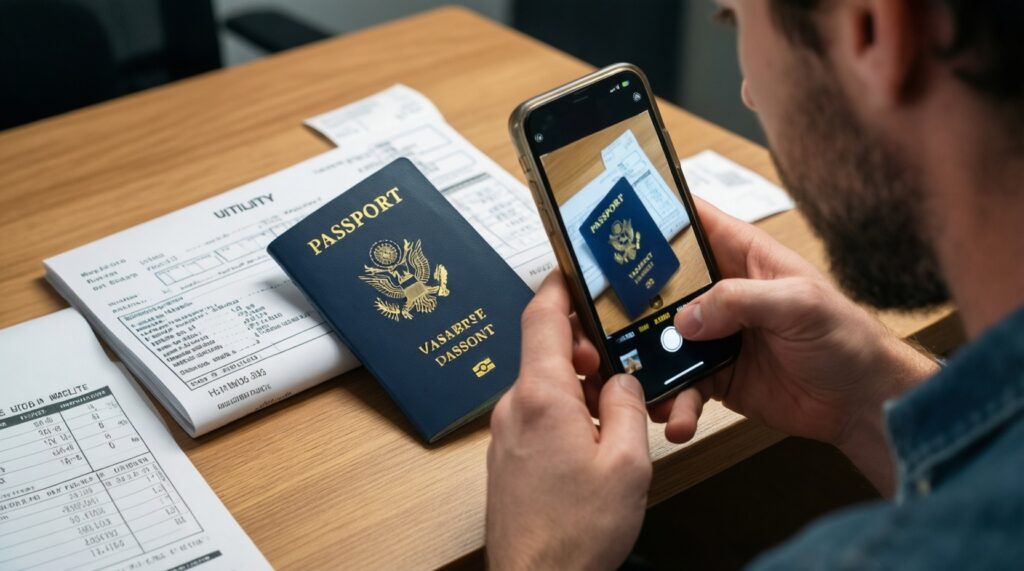
- Prepare the exact KYC documents required for your account type: one primary photo ID plus proof of address.
- Ensure all names, dates, and addresses match across documents and your profile details.
- Use high-resolution, unedited images; capture all corners and avoid glare, blur, and cropped edges.
- Plan for variable turnaround: approvals can be near-immediate or take a few business days if manual review is triggered.
- Expect escalation if deposits/withdrawals are large, details don't match, or your profile has AML risk flags (you may need source-of-funds documents).
- Use a consistent, auditable upload set: correct file names, complete metadata, and one document per file.
Identity Documents: acceptable IDs, image requirements and verification tips
Typical identity verification documents include a passport, national ID card, or driver's license. Use the document that best matches your current legal name and has the clearest security features. Avoid starting KYC verification if your ID is expired, damaged, or your profile name/address will not match the document set.
- Best choice: a valid passport or national ID with MRZ/holograms visible in the image.
- Front/back rule: if the ID is a card, upload both sides unless the provider explicitly says otherwise.
- Image rules: color, sharp focus, no filters, no screenshots of a camera roll, no heavy compression.
- Face match readiness: remove hats/masks; use neutral lighting; match your current appearance as closely as possible.
| Document type | Acceptability (typical) | Typical rejection reasons |
|---|---|---|
| Passport (photo page) | High | Glare on photo/MRZ, cropped edges, expired, low resolution |
| National ID card (front & back) | High | Missing back side, reflection on holograms, unreadable ID number, mismatched name format |
| Driver's license (front & back) | Medium | Address differs from proof of address, barcode/QR not legible, expired |
| Selfie / liveness capture | Required when prompted | Low light, face partially covered, camera focus issues, multiple faces in frame |
| Proof of address (utility/bank statement) | Conditionally accepted | Too old, missing full address, name mismatch, partial pages, edited PDF |
Proof of Address: utility bills, bank statements, digital docs and freshness rules
Have one proof-of-address document that shows your full name and full residential address exactly as entered in your profile. Many providers accept utility bills or bank statements; some accept official e-statements or government letters if they are clearly issued and verifiable.
- Documents to prepare: utility bill, bank statement, credit card statement, tax letter, or another official letter that includes name, address, issue date, and issuer identity.
- Digital access: access to your bank's e-statement portal and the ability to download the full PDF (not a screenshot).
- Consistency tools: your exact address formatting as used by the issuer (unit number, building, road, district, province) to avoid mismatches.
- Freshness: use the most recent issue available; if your document is older, expect additional checks or a request to re-upload.
- Thailand note: for KYC verification online, some providers may support local eKYC methods; still keep a traditional proof of address ready because not all workflows replace it.
AML Triggers and Enhanced Due Diligence: when additional paperwork is required
Enhanced Due Diligence (EDD) is a deeper review used to satisfy anti-money-laundering controls. It is commonly triggered by mismatches, unusual activity patterns, or risk signals that require extra evidence beyond standard KYC documents required.
Risk limits to understand before you start
- Submitting altered or misleading files can lead to permanent restrictions; only provide authentic documents.
- Uploading more data than requested increases exposure; share only what the portal asks for, unless support explicitly requests more.
- Third-party documents (someone else's bank statement or address proof) usually fail and can trigger account review.
- Repeated failed attempts can lock automated checks; pause, fix the root cause, then re-submit once.
-
Confirm what exactly triggered EDD
Check the verification status page and any emails for the specific missing item (source of funds, source of wealth, address mismatch, name mismatch). If the platform is vague, ask support to list the precise documents and acceptable formats.
- Keep all communication in the official support channel for an audit trail.
- Do not upload extra sensitive data "just in case".
-
Prepare source-of-funds evidence that matches your activity
Provide documents that explain where the money used on the platform comes from and how it reached you (salary, savings, business income, investments). Ensure the amounts and dates are consistent with your funding history.
- Examples: pay slips with matching bank credits, bank statements showing incoming transfers, broker statements.
- If using savings, include a statement trail showing accumulation rather than a single unexplained inflow.
-
Prepare source-of-wealth evidence only if requested
Source of wealth is broader (how you built your overall assets). Provide clear, high-level supporting documents that are proportionate to the request.
- Examples: employment letters, business registration and financial summaries, investment account history.
- Redact unrelated account numbers when allowed, but do not obscure names, dates, or issuer details.
-
Resolve identity and address mismatches systematically
Align your profile fields to the issuing documents (spelling, order of names, abbreviations, unit numbers). If you recently moved or changed your name, provide the official link document the reviewer can understand.
- Examples: name change certificate, marriage certificate, official change-of-address letter.
- If your address format differs by language, keep the same structure used on the proof-of-address document.
-
Re-submit once with a clean, complete package
Upload each document as a separate file, ensure all pages are included, and re-check legibility. A single coherent re-submission is usually faster than multiple partial uploads.
-
Escalate with a concise case summary if manual review stalls
If KYC process verification does not progress, send a brief message listing what you submitted, the document dates, and how they map to the request. Ask whether anything is unreadable or outside accepted criteria.
Submission Workflows: uploading, naming, metadata and common rejection causes
- File shows all corners of the document; nothing is cropped.
- Text is readable at 100% zoom; no motion blur or heavy compression artifacts.
- Correct document side(s) uploaded (front/back where applicable).
- One document per file; multi-page statements merged into a single PDF with all pages included.
- File name clearly identifies content (e.g., Passport_PhotoPage, BankStatement_MonthYear); avoid special characters that may break uploads.
- Profile metadata matches documents: full legal name, date of birth, residential address, country.
- Upload type matches content (don't submit a bank statement under "utility bill").
- No screenshots of PDFs or photos of screens; use original PDFs when allowed.
- Selfie/liveness done in good light; no hats, no sunglasses, no beauty filters.
Practical Steps to Accelerate Approval: pre-checks, automation and communication
- Using expired or near-expiry identity documents; renew first if possible.
- Entering an address that differs from your proof of address (missing unit/building, inconsistent abbreviations).
- Uploading a statement with a hidden issuer header/footer or missing page that contains your address.
- Submitting edited PDFs (even "minor" edits like contrast changes) that trip authenticity checks.
- Mixing languages or name order across files (e.g., different romanization); keep a single consistent spelling everywhere.
- Multiple re-uploads without changing anything, which can slow queues; fix the cause, then submit once.
- Funding first and trying KYC verification online later; do verification early to avoid withdrawal delays.
- Not responding to EDD requests promptly or sending long explanations without documents; lead with evidence, then a short mapping note.
Complex Profiles: corporate entities, trusts, PEPs and high-risk jurisdictions
If your situation goes beyond standard consumer verification, use the workflow that matches your risk profile and legal structure. These alternatives reduce back-and-forth and keep your submission auditable.
- Corporate account onboarding: suitable when funds flow through a registered company; expect UBO (beneficial owner) identity checks, company registry documents, and authorization proof for signatories.
- Trust/estate documentation route: suitable when assets are controlled by a trust or executor; prepare trustee/executor authority documents and beneficiary/settlor details if requested.
- PEP/high-risk enhanced review pack: suitable if you are a politically exposed person or closely associated; prepare a clear source-of-wealth narrative backed by primary documents.
- Alternative address verification: suitable when you lack standard utility bills; use an official letter or bank-issued correspondence that shows your full address and issue date.
Answers to frequent verification concerns and edge cases
What are the minimum KYC documents required for most accounts?
Usually one government-issued photo ID plus one proof of address. Some platforms also require a selfie or liveness step to confirm the ID belongs to you.
Can I complete KYC verification online without printing anything?
Often yes, if you upload high-quality photos and official PDFs from issuer portals. Avoid screenshots and ensure the full document (all pages) is included.
Why did my identity verification documents get rejected even though the photo looks clear?
Common causes are cropped corners, glare on security features, missing back side, or mismatched profile details. Re-check that the document type you selected matches what you uploaded.
How recent must proof of address be?
Use the most recent document available, because older documents are more likely to trigger a re-upload request. If you recently moved, be ready to provide a change-of-address supporting document if asked.
What triggers Enhanced Due Diligence during KYC process verification?
Mismatched details, unusual activity patterns, or risk indicators can prompt extra checks. When prompted, submit only the specific evidence requested (typically source of funds or source of wealth).
Can I use someone else's utility bill if I live with family?
Usually no; third-party documents commonly fail verification. Ask support whether they accept an official letter, a bank-issued address confirmation, or another document in your own name.