

If your goal is bankroll control and repeatable decisions, table games (especially blackjack with solid blackjack strategy) usually fit better than online casino slots, because you can manage variance with rules, bet sizing, and fewer high-volatility outcomes. Choose slots when you want simple entertainment, fixed decision load, and you can tolerate bigger swings for occasional big hits.
What to Prioritize When Choosing Between Slots and Table Games
- How long your bankroll must last (minutes vs hours) and whether you can leave a session at any time.
- Your tolerance for variance: steady small swings vs rare big spikes.
- Decision control: do you want choices that can reduce mistakes, or a pure push-button experience?
- Bet sizing flexibility: can you scale down without changing the whole feel of the game?
- Your "tilt risk": how likely you are to chase losses after a bad run.
- Goal clarity: entertainment, practice/learning, or "best casino games to win money" thinking (i.e., lowest avoidable mistakes).
Mathematical Edge: RTP, Variance and House Advantage
- Published RTP vs controllable edge: many slots display an RTP, but you can't influence it; in some table games, correct decisions can reduce avoidable losses compared with random play.
- Variance profile: low-volatility games smooth results; high-volatility games can look "dead" for long stretches then spike (typical for many online casino slots).
- Outcome distribution: table games often have more frequent small wins/losses; slots can concentrate value into bonus rounds or rare events.
- Hands/spins per hour: faster game pace increases bankroll swing speed; slowing decisions can be a hidden bankroll tool in table games.
- Rule sensitivity: table games change a lot with rules (decks, payouts, side bets); slots change with paytables/features (bonus frequency, max exposure).
- Side bets and "features": side bets in tables and feature buys in slots typically add cost/volatility-treat them as entertainment spend, not "best casino games for bankroll" choices.
- Stop-win/stop-loss practicality: high variance makes stops harder to execute because outcomes cluster; lower variance supports cleaner stop rules.
- Error rate: every decision point is an opportunity to leak EV; if you won't follow a plan, simpler games can be mathematically "better for you" even if not theoretically optimal.
Quick comparison snapshot (practical, not a promise)
| Game type | RTP / edge transparency | Variance | Skill factor | Typical bet sizing feel | Expected session length on a fixed bankroll |
|---|---|---|---|---|---|
| Slots (low volatility) | Often published per game; not player-controlled | Lower to medium | Low | Easy to scale down per spin | Often longer than high-volatility slots at same bankroll |
| Slots (high volatility) | Often published per game; not player-controlled | High | Low | Feels "swingy"; bankroll jumps/drops | Often shorter unless a spike happens |
| Blackjack (with basic play) | Rule-dependent; player decisions matter | Medium | Medium to high | Works well with flat or small ramps | Often steadier if pace and bet size are controlled |
| Roulette | Simple, fixed math; no decision edge | Medium | Low | Many staking systems tempt overbetting | Can drain faster if you increase bets while chasing |
Bankroll Management Strategies for Slots vs Table Games
Use a bankroll rule that matches variance. A simple, actionable starting point: decide a "unit" as 1% of your session bankroll for steadier games, and 0.25%-0.5% for higher-volatility play. Example: with 5,000 THB, a steadier unit is ~50 THB; a high-volatility unit is ~12-25 THB. Adjust based on how fast you want the session to end.
| Variant | Who it suits | Pros | Cons | When to choose |
|---|---|---|---|---|
| Low-volatility slots (small, steady spins) | Recreational players who want low effort and longer playtime |
|
|
When your main goal is entertainment time per THB and minimal decisions |
| High-volatility slots (jackpot/feature-focused) | Players explicitly buying swings for rare spikes |
|
|
When you can afford the variance and your plan is "small unit, fixed time cap" |
| Blackjack (basic strategy, no side bets) | Learners and "sharps" who enjoy structured decisions |
|
|
When you want the most control over your results within "slots vs table games" |
| Baccarat (Banker-focused, avoid side bets) | Intermediate players who want low decision load with table pacing |
|
|
When you want table-game structure without complex decision trees |
| Roulette (single-zero where possible; flat betting) | Recreational players who like simple wagers and social pace |
|
|
When you can commit to flat bets and you're not seeking "best casino games to win money" logic |
| Poker (cash or tournaments, if available) | Sharps with patience, study habit, and emotional control |
|
|
When you want a skill-centric path and can handle longer downswings |
Skill, Decision-Making and the Learning Curve
- If you will actually study and follow a chart, then blackjack with basic strategy (and strict avoidance of side bets) usually beats "winging it" in most table games.
- If you know you'll play tired, distracted, or after drinks, then pick low-decision games (low-volatility slots or simple baccarat) and shrink unit size.
- If you like "systems" and feel tempted to martingale/chase, then avoid roulette staking progressions; choose flat-bet blackjack/baccarat with preset stops.
- If you're switching between many games in one night, then treat each switch as a new session with a new mini-bankroll to prevent silent overexposure.
- If your main fun is solving problems, then spend your learning time on blackjack strategy fundamentals or poker basics, not on complex slot "patterns" (they don't transfer).
Session Planning: Time, Bet Sizing and Volatility
- Pick your session bankroll (money you can lose today) and lock it-no top-ups.
- Choose a unit size: ~1% for steadier play, ~0.25%-0.5% for high volatility.
- Set a time cap (for example, one hour) and a hard stop-loss (for example, 20-40 units depending on volatility).
- Decide your pace control: slow down in table games; limit turbo/autospin in slots.
- Pre-commit to one "risk mode": either entertainment (slots) or execution (tables). Don't mix modes mid-tilt.
- Define a stop-win that is realistic (e.g., +10-20 units), then leave-don't "press" just because you're ahead.
Player Psychology: Entertainment, Tilt and Motivation
- Confusing excitement with profitability: high variance feels like "potential," but it's often just bigger bankroll swings.
- Chasing losses by changing games: switching from slots to tables (or the reverse) mid-tilt usually increases mistakes and bet sizes.
- Overbetting after a win: "house money" thinking breaks bankroll rules fastest in roulette and slots.
- Ignoring pace: fast spins/hands can quietly multiply your exposure per hour.
- Leaning on staking systems: progressions don't remove the underlying edge; they concentrate risk.
- Side-bet creep: one optional bet becomes five; your session risk doubles without you noticing.
- Autopilot: especially with online casino slots, you can overspin past your stop points unless you schedule pauses.
- Goal mismatch: playing "best casino games for bankroll" while emotionally demanding jackpot-style outcomes is a built-in conflict.
Persona-Based Recommendations: Recreational, Sharps, Learners, High-Rollers
For Recreational players prioritizing simplicity and time-on-device, low-volatility slots are usually the best fit; for Sharps who want control within slots vs table games, blackjack with disciplined blackjack strategy and no side bets is typically the strongest choice; for Learners, baccarat (simple) or blackjack (structured) works well depending on study commitment; for High-rollers, table games with strict limits and lower "feature creep" are often easier to manage than high-volatility slots.
Short Practical Answers for Typical Player Situations
I have a small bankroll and want it to last-what should I play?

Choose low-volatility slots with small units or a simple table game with flat betting (baccarat or blackjack if you'll follow basic strategy). Avoid high-volatility slots and avoid roulette progressions.
I'm chasing a big payout in a short session-slots or tables?
High-volatility slots match that goal better, but shrink your unit size and set a hard time cap. Treat it as entertainment spend, not "best casino games to win money" planning.
I want the most control over outcomes-what's the practical pick?
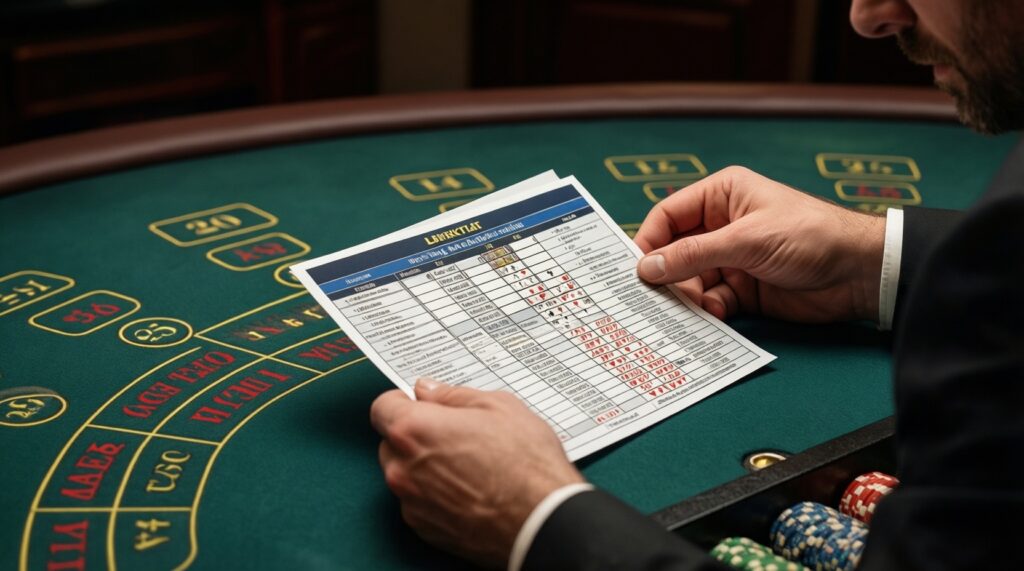
Blackjack with a memorized blackjack strategy chart (and no side bets) gives you the cleanest decision control. If you won't study, baccarat is the simpler controlled alternative.
I tilt easily after losses-what should I avoid?
Avoid fast, high-variance formats: turbo/autospin online casino slots and roulette with staking systems. Pick slower pace games with flat bets and pre-set breaks.
I keep switching games when I'm down-how do I stop leaking bankroll?
Lock a single game for the session and define a stop-loss in units before you start. If you must switch, reset with a new mini-bankroll and a fresh stop rule.
Is roulette a good "best casino games for bankroll" option?
It can be fine for entertainment with flat betting and strict stops, but it's fragile if you chase or use progressions. If bankroll stability is the goal, controlled table choices often behave better.