

To calculate the real value of a casino welcome bonus, convert the offer into a cash-equivalent and then discount it for wagering requirements, game eligibility, time limits, and cashout caps. You will compare your expected loss from required play versus the bonus value, using RTP, bet sizing, and rule compliance to estimate a conservative expected value (EV).
Practical Summary for Immediate Use
- Start from the worst-case interpretation of the terms (eligible games, max bet, deadlines) and only "upgrade" if explicitly allowed.
- Convert every component (match %, free spins, bonus chips) into one currency (THB or your account currency) before calculating EV.
- Compute required turnover from wagering rules, then estimate expected loss using Expected loss = Turnover × (1 − RTP).
- Apply hard "kill switches": short time limits, strict max-bet rules, or low withdrawal caps can reduce EV to near zero even when the headline looks big.
- Build sensitivity rows: check EV under a lower RTP game, a smaller bet size, and a stricter eligible-games list.
- Pick a risk profile (low/medium/high) and only choose a sign up bonus casino offer that remains positive under your conservative scenario.
Cataloguing Welcome Offer Types and Their Contractual Hooks
A casino welcome bonus can be valuable when the wagering multiple is moderate, the eligible games include high-RTP options you actually play, and the rules are realistic for your bankroll and schedule. Skip it when the terms are ambiguous, the bonus is "sticky" with harsh restrictions, or the max-cashout makes the upside irrelevant.
- Deposit match (e.g., 100% up to X): Main hooks are wagering multiple on bonus and/or deposit, eligible games, and max bet while wagering.
- Free spins (FS): Hooks include fixed stake per spin, winnings credited as bonus (not cash), and separate wagering on FS winnings.
- Bonus buy-in / bonus funds / "casino credits": Often non-withdrawable, sometimes "sticky" (you can withdraw winnings only), with strict cashout caps.
- No-deposit bonus: Usually small but heavily capped; treat it as a capped coupon, not as cash.
If you are comparing best welcome bonus offers, normalize them by the same method (cash-equivalent EV after all rules), not by headline percentage.
Translating Bonus Currency into Real Cash Value
You need the offer text and the full terms, plus a few inputs from the games you will actually use. This is the minimum toolkit to evaluate a best online casino sign up bonus without guessing.
- Your planned deposit (THB) and the match formula (e.g., 100% up to a cap).
- Wagering rules: what amount is wagered (bonus only vs deposit+bonus), the multiple (e.g., 35×), and contributions (slots 100%, some games 10%, some excluded).
- Game RTP for your eligible games (use the game's info panel; don't assume a single RTP across a provider).
- Bet constraints: max bet per spin/hand while wagering; whether bonus buy features are allowed.
- Time limits: activation window and completion deadline (hours/days), including "no play for X days resets" clauses.
- Cashout controls: max cashout/withdrawal cap, minimum withdrawal, and any "winnings cap" from free spins.
- Bankroll comfort: the maximum drawdown you can tolerate; this affects game choice and bet sizing.
Calculating Expected Value (EV) with Wagering Constraints
- Rule-risk in TH context: promos can be voided for max-bet breaches, excluded games, or bonus feature buys; treat unclear wording as prohibited.
- Liquidity risk: some offers lock funds until wagering is complete; ensure you can finish without needing to withdraw early.
- Time risk: deadlines can force higher bet sizes; if you must rush, your practical EV drops.
- Variance risk: even positive EV can lose in the short run; a conservative estimate should assume you might hit a downswing.
-
Convert the headline into bonus amount (THB)
For a match offer: Bonus = min(Deposit × Match%, Bonus cap). Example: Deposit 2,000 THB, match 100% up to 2,000 THB → Bonus = 2,000 THB.
-
Identify what is actually wagered
Check whether wagering applies to (a) bonus only or (b) deposit + bonus. This single line changes the required turnover dramatically.
- Bonus-only: Wager base = Bonus.
- Deposit+bonus: Wager base = Deposit + Bonus.
-
Compute required turnover (the wagering requirement)
This is the core of how to calculate bonus wagering requirements: Required turnover = Wager base × Wagering multiple ÷ Game contribution.
Example: (Deposit+Bonus) = 4,000 THB, wagering 30×, slots contribution 100% → Required turnover = 4,000 × 30 ÷ 1.0 = 120,000 THB.
-
Estimate expected loss from required play
Use Expected loss = Required turnover × (1 − RTP), with RTP as a decimal. Example: RTP 96% → house edge 4% → expected loss = 120,000 × 0.04 = 4,800 THB.
-
Compute base EV before caps and penalties
For a simple match bonus, a conservative baseline is EV ≈ Bonus − Expected loss (then adjust for caps, rule risk, and eligibility). Example: Bonus 2,000 THB − 4,800 THB = −2,800 THB (not worth it).
-
Discount EV for restrictions and compliance risk
If a rule is easy to break (max bet, excluded games, "irregular play"), apply a conservative discount by assuming you must use smaller bets, fewer games, and no feature buys. If the offer becomes negative under strict compliance, treat it as negative.
-
Compare offers using the same method
When picking a casino welcome bonus or comparing a sign up bonus casino deal to another, compute EV with the same RTP assumption and the strictest eligible-game list you can verify.
Incorporating Time Limits, Max Bet Rules and Withdrawal Caps
- Deadline to finish wagering is long enough for your planned bet size and playtime (no "must finish today" pressure).
- Max bet rule is compatible with your plan (and you can keep every spin/hand under the limit).
- Eligible games list includes your intended high-RTP titles; excluded categories (live, table, bonus buys) won't force you into worse RTP.
- Game contribution rates are acceptable (avoid offers where your realistic games contribute 10% or 0%).
- Free spins winnings are credited as cash or as bonus; if bonus, confirm the extra wagering multiple and any winnings cap.
- Max cashout/withdrawal cap does not truncate your upside below your realistic win range while clearing wagering.
- Winnings cap applies only to the bonus portion (if unclear, assume it caps withdrawals overall).
- Country/region eligibility and KYC requirements are feasible before withdrawal (documents, name matching, payment method ownership).
- Payment method restrictions won't block withdrawals (some promos exclude specific wallets/cards).
Adjusting for Game Volatility, RTP and Bet Size Sensitivity
- Using an assumed RTP: don't use a provider average; use the specific game RTP shown in-game, and only if that game is eligible for wagering.
- Ignoring contribution rates: a 10% contribution multiplies turnover by 10; treat low contributions as a near-dealbreaker unless the multiple is tiny.
- Breaking max bet accidentally: one oversized spin can void a bonus; plan a "max-bet buffer" (e.g., stay well below the stated maximum).
- Underestimating volatility: high-volatility slots can bust your bankroll before finishing turnover even if EV looks OK; use lower volatility for clearance reliability.
- Forgetting separate wagering on free spins winnings: FS often has its own wagering and cap; treat FS winnings as bonus funds unless stated otherwise.
- Misreading wagering base: "wager bonus and deposit" vs "wager bonus only" changes everything; confirm the exact base before you compare.
- Not checking withdrawal caps: a strong-looking best welcome bonus offers page may feature deals where you can only withdraw a small capped amount from bonus-related winnings.
- Rushing due to time limits: increasing bet size to meet a deadline increases variance and can convert a borderline-positive EV into a practical loss.
Worked Examples and a Reusable Calculation Table
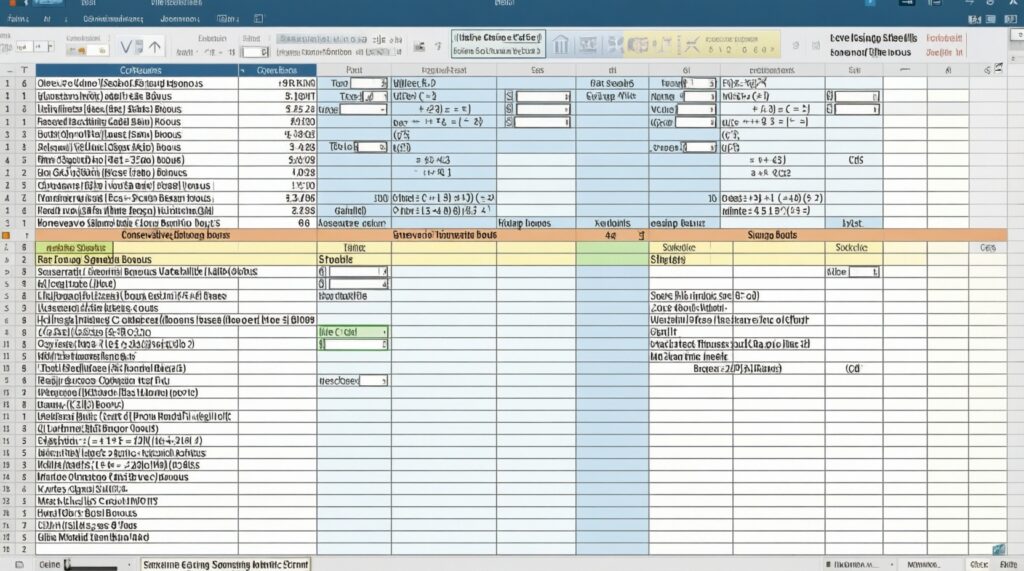
Use the template below to compare any best online casino sign up bonus consistently. Fill it twice: once with a strict, conservative scenario (recommended) and once with an optimistic scenario (only if every term is explicit).
| Line item | Formula (units) | Example input | Example result | Sensitivity check (conservative vs optimistic) |
|---|---|---|---|---|
| Deposit | D (THB) | 2,000 | 2,000 THB | Conservative: smaller D you can finish wagering with |
| Match bonus | B = min(D × m, cap) (THB) | m = 100%, cap = 2,000 | 2,000 THB | Conservative: assume cap binds; Optimistic: full match if eligible |
| Wager base | WB = B or (D + B) (THB) | Deposit+Bonus | 4,000 THB | Conservative: assume D+B unless clearly bonus-only |
| Contribution | c (0-1) | Slots: 1.0 | 1.0 | Conservative: use your actual eligible game's c |
| Wagering multiple | w (×) | 30× | 30 | Conservative: include any extra wagering on FS winnings |
| Required turnover | T = WB × w ÷ c (THB) | WB 4,000; w 30; c 1.0 | 120,000 THB | Conservative: if c = 0.5 then T doubles |
| RTP used | R (decimal) | 0.96 | 0.96 | Conservative: lower eligible RTP; Optimistic: best eligible RTP |
| Expected loss | L = T × (1 − R) (THB) | T 120,000; R 0.96 | 4,800 THB | Conservative: use lower R and higher T if any ambiguity |
| Base EV (pre-caps) | EV ≈ B − L (THB) | B 2,000; L 4,800 | −2,800 THB | Conservative: apply compliance discount and caps |
| Cashout cap impact | EV_final = min(EV upside, cap effects) | Cap unclear | Treat as lower EV | Conservative: assume cap truncates large wins from bonus play |
Alternative paths by risk profile (when each is appropriate)
- Low-risk (compliance-first) clearance: choose low/medium volatility eligible slots, bet well below max bet, and accept a lower "headline" if it has clearer rules and longer deadlines. Best when you want predictable completion and minimal void risk.
- Medium-risk (value-first) selection: only take offers that remain non-negative under conservative RTP and contribution assumptions, then optimize by selecting the highest eligible RTP games and keeping variance moderate. Best for regular players who can finish turnover calmly before the deadline.
- High-risk (variance-tolerant) approach: treat the bonus as a high-variance coupon; you may choose higher volatility within allowed games, but only if you can still comply with max bet and time rules. Best when you accept drawdowns and still pass all rule constraints.
Troubleshooting Common Bonus Pitfalls
Why does my calculated EV look negative even with a big match?
If wagering applies to deposit+bonus, turnover can be large enough that expected loss exceeds the bonus. Re-check the wagering base, contribution rates, and the RTP of eligible games.
How do I value free spins in a casino welcome bonus?
Value them as expected winnings from the spins, then check whether winnings are bonus funds and what extra wagering applies. If there is a winnings cap, treat the free spins value as capped.
What if the terms don't clearly state whether tables or live games contribute?
Assume they contribute 0% unless explicitly listed as eligible with a stated contribution rate. Ambiguity is a risk factor that should push your EV estimate downward.
How do withdrawal caps change the best welcome bonus offers comparison?
A cap can limit your maximum withdrawable winnings from bonus play, shrinking the upside while the wagering cost remains. If the cap is low relative to required turnover, treat the offer as low value.
Can a max bet rule really void a sign up bonus casino offer?

Yes-many casinos reserve the right to cancel bonus winnings for exceeding max bet during wagering. Plan a strict bet ceiling below the stated limit and avoid auto-features that change stake size.
What's the fastest way to sanity-check how to calculate bonus wagering requirements?
Compute turnover twice: once assuming deposit+bonus and once assuming bonus-only, then check the terms to see which applies. If you cannot verify it, use the higher turnover for your decision.
Why does the best online casino sign up bonus sometimes feel impossible to clear?
Short deadlines, low contribution games, and high volatility can cause bust-out before completion. Switch to eligible higher-RTP, lower-volatility games and reduce bet size to improve completion probability.